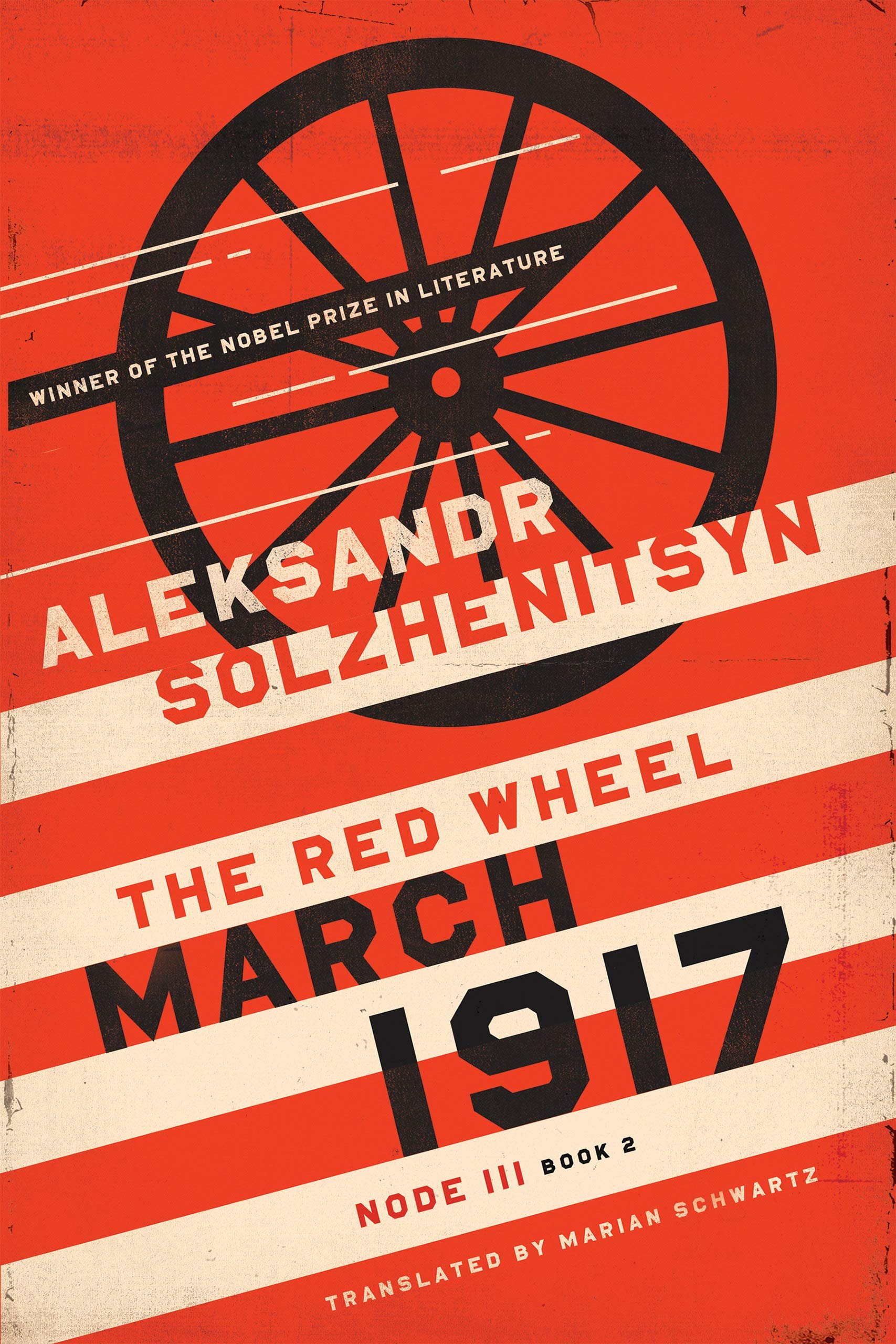
PUBLISHED TODAY: La Roue Rouge. Chapitres choisis

In this new French-language volume, curated by renowned Solzhenitsyn scholar Georges Nivat, but modeled faithfully on Solzhenitsyn’s own Russian abridgment of The Red Wheel, many of the crucial chapters, historical characters, and events are brought forth once again to the French reader in an edition that is sure to be warmly received and stay n print for many years.

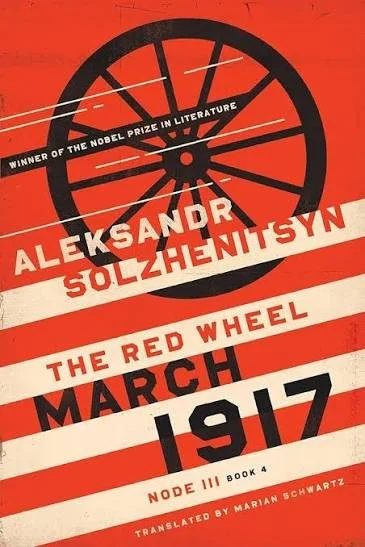
PUBLISHED TODAY: March 1917, Book 4 re-issued in paperback

Book 4 of March 1917, first published in English by Notre Dame Press two years ago, has been released today in paperback.  See a short video introducing the book here. To catch up on The Red Wheel from the beginning, read August 1914, October 1916, Book 1 of March 1917, Book 2 of March 1917, Book 3 of March 1917, then this Book 4. April 1917, Book 1 came out in hardcover in 2025. April 1917, Book 2 is due out in Autumn 2027.


Catch-up Review for Readers of The Red Wheel

Here is a very helpful “catch-up” of where things stand in The Red Wheel saga. Tom Bowden, over at Book Beat, recaps the four volumes of March 1917 and reviews April 1917, Book 1.

“The completed work stretches from August 1914 to May 1917, and is divided into four parts, or nodes as he called them, with reference to their mathematical meaning as a fundamental point of interest within a structure or network. That is, each node may be read without reference to the others, even though they appear on a timeline as part of a continuum. (Both August 1914 and November 1916 are published in English as single volumes of about 900 pages each.)

An implication of organizing the novels this way is that it suggests—and the novels repeatedly bear this out—that at almost any point during almost any single event along this timeline, events could have gone otherwise. There is nothing deterministic about the sequence of occurrences, and thus the series may be read as anti- or at least non-Marxist in outlook.”
— Tom Bowden

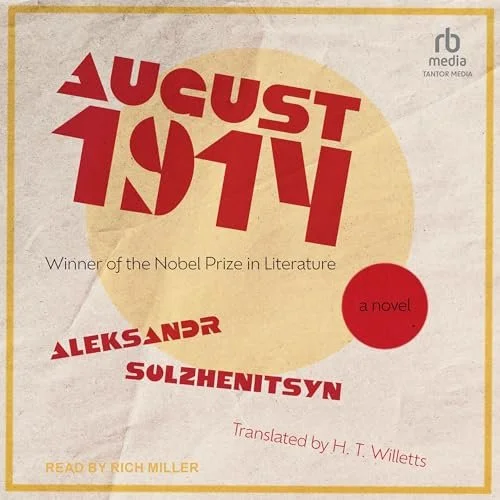
New audiobook of August 1914, narrated by Rich Miller

cover of August 1914 audiobook

Tantor Media have issued a new audiobook of August 1914, narrated by Rich Miller. Here is an excerpt from Chapter 82.

from August 1914, Chapter 82
“There were no large rooms in the building. The biggest of them would hold twenty in a pinch. There were in fact just twenty officers in the Quartermaster General’s department, but more than half as many again had gathered that morning.

Two short tables had been placed at right angles to each other. At the head of one sat the Supreme Commander, even when seated the tallest man present. Next to him—they were inseparable—was his brother. Grand Duke Pyotr Nikolaevich, dutifully taking it all in (although everybody knew that for years past he had been preoccupied with church architecture and uninterested in military matters). Next to him was their cousin, the choleric Prince Pyotr of Oldenburg (“Poppycock Pasha”). Then came the Adjutant General, Illustrious Prince Dmitri Golitsyn (master of the royal hunt in recent years). Then General Petrovo-
Solovovo, the debonair marshal of the Ryazan nobility, now a“general-in-waiting.” ”
— from August 1914, Chapter 82

Retracing a Catastrophe

Over at Civitas Outlook, the esteemed Paul Seaton reviews April 1917, Book 1, and the broader philosophical issues with which Solzhenitsyn grapples in his works.

“Indispensable during the Cold War, Aleksandr Solzhenitsyn’s writings remain essential for our times and troubles. This, for a number of reasons. First, he is one of the handful of essential analysts of Ideology with a capital “I”. In his historical and literary writings, he vividly brings to light the modern Manichean form of thinking that divides humanity into good and evil camps and groups, thereby falsifying history, morality, and politics. As Ideology has continued to exist in transmogrified forms after its Marxist-Leninist version, he remains a sure guide into its dark labyrinths.

Second, in analyzing the great twentieth century test case of leftist Ideology coming to power in his beloved Russia, he shows us how to detect its methods of coming to power and to foresee what it will do as it consolidates its power. The active, scheming Ideologue and revolutionary is a type refracted in a thousand figures, and Solzhenitsyn’s historico-literary art captures both. ”
— Paul Seaton

The Turn of the Wheel

In the January issue of the New Criterion (paywall), Daniel J. Mahoney reviews the penultimate installment in The Red Wheel—April 1917, Book 1.

“With the publication of the first book of April 1917, we have arrived at the fourth and final “node” of Solzhenitsyn’s literary and historical masterwork The Red Wheel.1 The four books of March 1917 are now behind us. In them, Solzhenitsyn brilliantly “recounts the revolution as it unfolds in Petrograd, as riots go unchecked, the tsar falters and abdicates, but both the state and the numerous opposition leaders are incapable of controlling events,” to cite the publisher’s note that precedes the volume. This first book of April 1917, covering the period from April 11 to May 5, 1917, “captures the division and helplessness of Russia’s first revolutionary rulers, paving the way for the victory of the ruthless Bolsheviks later this year.”
— Daniel J. Mahoney

Shepherd Express review of April 1917, Book 1

David Luhrssen reviews April 1917, Book 1 at the Shepherd Express.

“The dense complexity is striking as characters, real and composite, personify the passage of history—not as Marx’s vast impersonal forces but as people in their moment. A multitude of events are crammed into the massive novel’s timeframe, April 11-May 5, 1917, as they were in real life. Solzhenitsyn doesn’t try to simplify the situation and its many actors into an easy narrative.”
— David Luhrssen

Why Lenin Won

Go here for a major review of April 1917, Book 1 by Gary Saul Morson, writing at Law & Liberty.

“Solzhenitsyn used his skill as a novelist primarily by relating events from the perspective of one or another historical character, whose thoughts he traces from within, sometimes by quoting their inner speech and at other times by using the conventional novelistic technique of “free indirect discourse” (or “double-voicing”). Though narrated in the third person, these chapters trace the sequence of thoughts that occur to a given character in the words he might use. Along with the character’s voice, we hear the author’s often ironic commentary, and so register two points of view at once. Historians, of course, cannot use this method because people do not document their thoughts as they think them. In Solzhenitsyn’s hands, double voicing became a potent tool of satire, and it is satire that defines the overriding tone of all the Red Wheel novels, as it does The Gulag Archipelago.”
— Gary Saul Morson

PUBLISHED TODAY: April 1917, Book 1

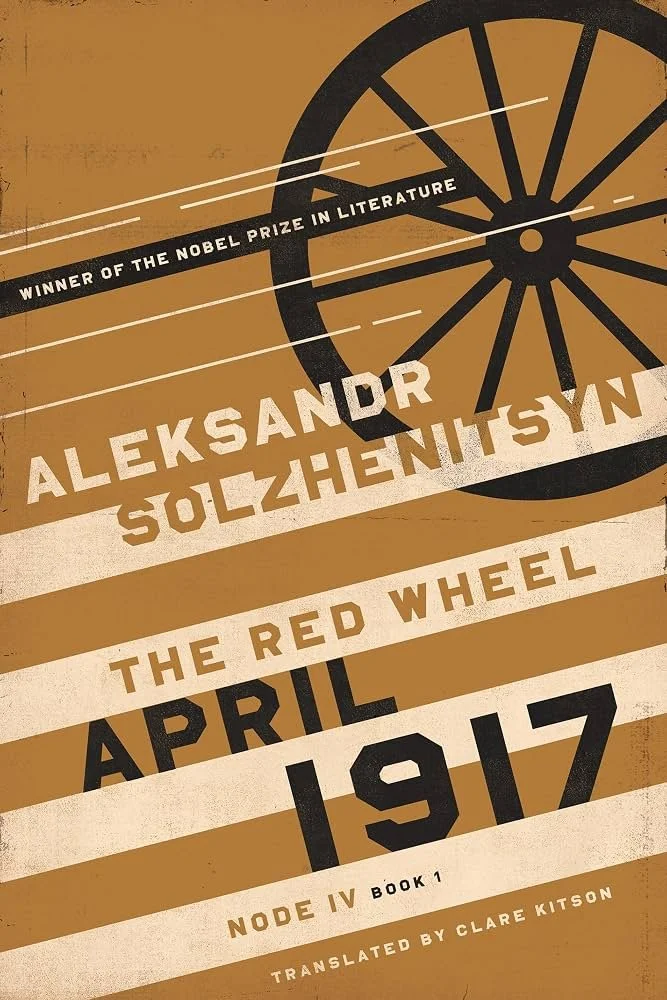
The Red Wheel, Node IV, April 1917, Book 1 is available today for the first time in English from University of Notre Dame Press, from Amazon or wherever books are sold.

The action of Book 1 (of two) is set during April 11–May 5, 1917. Book 1 presents an early showdown, just seven weeks into the revolution, between its various wings. The Provisional Government comes under fire for its “bourgeois” capitalism and continuing commitment to World War I. Bolshevik leader Vladimir Lenin returns from exile and delivers his April Theses in Petrograd, actively sowing seeds of division. He declares that the revolution is not complete and openly calls for civil war, outlining a radical plan to overthrow the Provisional Government and seize power for the Soviets. Amid the chaos and rising tide of Bolshevism, the elements of resistance, and decency, slowly begin to awaken.

We remind Solzhenitsyn readers of the overall sequence of the 10-book Red Wheel:
Node I: August 1914, Books 1 & 2 (Farrar, Straus & Giroux, published in one volume)
Node II: November 1916, Books 1 & 2 (Farrar, Straus & Giroux, published in one volume)
Node III: March 1917, Book 1 (University of Notre Dame Press)
Node III: March 1917, Book 2 (University of Notre Dame Press)
Node III: March 1917, Book 3 (University of Notre Dame Press)
Node III: March 1917, Book 4 (University of Notre Dame Press)
Node IV: April 1917, Book 1 (University of Notre Dame Press)
Node IV: April 1917, Book 2 (forthcoming—University of Notre Dame Press)

To inform readers about Solzhenitsyn’s system of “Nodes”, and also to explain the definitive term “Node” (instead of the older “Knot”), here is a portion of the Publisher’s Note that accompanies each of the Notre Dame volumes:

The English translations by H.T. Willetts of August 1914 and November 1916, published by Farrar, Straus and Giroux in 1989 and 1999, respectively, appeared as Knot I and Knot II. The present translation, in accordance with the wishes of the Solzhenitsyn estate, has chosen the term “Node” as more faithful to the author’s intent. Both terms refer, as in mathematics, to discrete points on a continuous line. In a 1983 interview with Bernard Pivot, Aleksandr Solzhenitsyn described his narrative concept as follows: “The Red Wheel is the narrative of revolution in Russia, its movement through the whirlwind of revolution. This is an immense scope of material, and . . . it would be impossible to describe this many events and this many characters over such a lengthy stretch of time. That is why I have chosen the method of nodal points, or Nodes. I select short segments of time, of two or three weeks’ duration, where the most vivid events unfold, or else where the decisive causes of future events are formed. And I describe in detail only these short segments. These are the Nodes. Through these nodal points I convey the general vector, the overall shape of this complex curve.”

Short Video Introducing April 1917, Book 1

Learn more about the forthcoming English publication of April 1917: The Red Wheel, Node IV, Book 1, due out for the first time in English, translated by Marian Schwartz, 1 November 2025 from University of Notre Dame Press.

APRIL 1917 The Red Wheel, Node IV, Book 1 Aleksandr Solzhenitsyn Available November 2025 wherever books are sold University of Notre Dame Press undpress.nd.edu

Russian Roulette

Dominic Green reviews March 1917, Book 4 in The Lamp.

“When he began writing the first “node” of his cycle, August 1914, in 1969, Solzhenitsyn intended to follow the story to 1922, the year in which the Bolshevik regime, having won the civil war, solidified its rule and formed the Soviet Union. Solzhenitsyn halted the cycle with April 1917 after twenty years of labor. By 1989, the Soviet Union was on its deathbed, Solzhenitsyn was suffering from angina, and his readers were losing interest. The complete—which is to say, incomplete—Red Wheel has ten volumes in the original Russian. The “whirlwind of revolution” is slowed into four nodes, each covering two or three critical weeks, and each narrated through hundreds of fragmentary chapters and dozens of real and fictional characters.”
— Dominic Green

Solzhenitsyn on Russia's Moment of Crisis

In the Wall Street Journal, Gary Saul Morson continues his series of reviews of volumes of The Red Wheel with this excellent piece on March 1917, Book 4.

“The great British historian Herbert Butterfield cautioned against the temptation to tell a neat story about historical events or discover “an unfolding logic” in them. History, he argued, is constructed “not by a line but by a labyrinthine piece of network” comprised of “strange conjunctures” with “purposes marred perhaps more than purposes achieved.” That is precisely the picture Alexander Solzhenitsyn presents in the four volumes of “March 1917,” his series of historical novels, written between 1969 and 1991, that describe the chaotic events surrounding the abdication of Czar Nicholas II and the nominal transfer of power to the Duma and its Provisional Government. An attempt to understand how Russia descended into the horrors described in Solzhenitsyn’s “The Gulag Archipelago” (1973), it demonstrates how the Bolshevik takeover could have and should have been avoided.”
— Gary Saul Morson

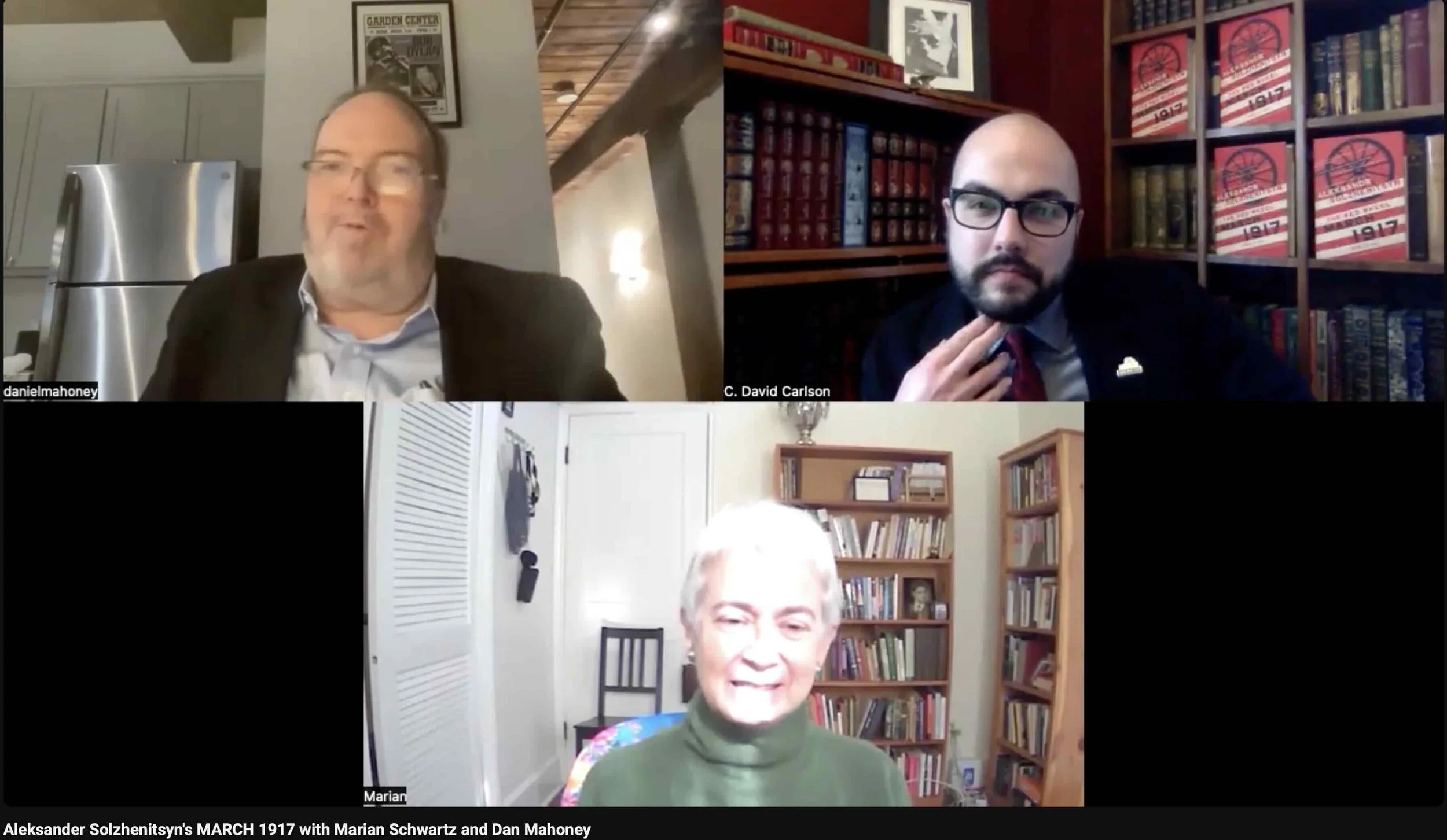
Video of Marian Schwartz and Daniel J. Mahoney on March 1917

In this latest Books for Better Understanding video from Notre Dame Press, David Carlson facilitates a conversation between Marian Schwartz and Dan Mahoney about Aleksandr Solzhenitsyn's MARCH 1917: THE RED WHEEL, NODE III, all four books of which are now fully available in English for the first time. Schwartz and Mahoney discuss the historical, literary, and cultural significance of March 1917.

The Middle Path Forsworn

Over at Law and Liberty, Daniel J. Mahoney has an in-depth review of the just-published concluding Book 4 of March 1917, which is itself Node III of the four Nodes of The Red Wheel. The final section of the review essay discusses the enduring value of The Red Wheel for contemporary readers in Russia and the West alike.

“In the closing half of the volume, Lenin, still in exile in Zurich, Switzerland, becomes more and more of a looming presence. Other revolutionaries have already returned home to Russia and Lenin is eager to join them. Lenin is shrewd, daring, single-minded, fanatical, and devoid of moral scruples in the ordinary sense of the term. As with all Solzhenitsyn’s main characters, we hear Lenin’s thoughts from the inside, so to speak, even if the author has no sympathy for his machinations or the ideological fanaticism that drives them. This diversity of inner voices heightens the interest and intelligibility of the drama. The Red Wheel is in no way “monologic” even if its author is anything but neutral in the great contest between civilized order and revolutionary subversion.”
— Daniel J. Mahoney

PUBLISHED TODAY: March 1917, Book 4

The Red Wheel, Node III, March 1917, Book 4 is available today for the first time in English from University of Notre Dame Press, from Amazon or wherever books are sold.

The action of Book 4 is set during March 23–31, 1917. Book 4 portrays a cast of thousands in motion and agitation as every stratum of Russian society—the army on the front lines, the countryside, the Volga merchants, the Don Cossacks, the Orthodox Church—is racked by the confusing new reality. Soldiers start to fraternize across trenches with the enemy. The Grand Duke Nikolai Nikolaevich, the emperor’s uncle, arrives at military headquarters to assume the supreme command but is promptly dismissed by the new Provisional Government. But this government, too, holds no power, for at every step it is cowed and hemmed in by a self-proclaimed and unaccountable Executive Committee acting in the name of the Soviets—councils of workers and soldiers. And the Soviets themselves are divided—on whether to call for an end to the war or for its continuation, on whether to topple the Provisional Government or to let it try to govern. Meanwhile, in Switzerland, Lenin quietly dictates his own terms to the German General Staff, setting the stage for his return to Russia.

We remind Solzhenitsyn readers of the overall sequence of the 10-book Red Wheel:
Node I: August 1914, Books 1 & 2 (Farrar, Straus & Giroux, published in one volume)
Node II: November 1916, Books 1 & 2 (Farrar, Straus & Giroux, published in one volume)
Node III: March 1917, Book 1 (University of Notre Dame Press)
Node III: March 1917, Book 2 (University of Notre Dame Press)
Node III: March 1917, Book 3 (University of Notre Dame Press)
Node III: March 1917, Book 4 (University of Notre Dame Press)
Node IV: April 1917, Book 1 (forthcoming—University of Notre Dame Press)
Node IV: April 1917, Book 2 (forthcoming—University of Notre Dame Press)

To inform readers about Solzhenitsyn’s system of “Nodes”, and also to explain the definitive term “Node” (instead of the older “Knot”), here is a portion of the Publisher’s Note that accompanies each of the Notre Dame volumes:

The English translations by H.T. Willetts of August 1914 and November 1916, published by Farrar, Straus and Giroux in 1989 and 1999, respectively, appeared as Knot I and Knot II. The present translation, in accordance with the wishes of the Solzhenitsyn estate, has chosen the term “Node” as more faithful to the author’s intent. Both terms refer, as in mathematics, to discrete points on a continuous line. In a 1983 interview with Bernard Pivot, Aleksandr Solzhenitsyn described his narrative concept as follows: “The Red Wheel is the narrative of revolution in Russia, its movement through the whirlwind of revolution. This is an immense scope of material, and . . . it would be impossible to describe this many events and this many characters over such a lengthy stretch of time. That is why I have chosen the method of nodal points, or Nodes. I select short segments of time, of two or three weeks’ duration, where the most vivid events unfold, or else where the decisive causes of future events are formed. And I describe in detail only these short segments. These are the Nodes. Through these nodal points I convey the general vector, the overall shape of this complex curve.”
PUBLISHED TODAY: March 1917, Book 3 re-issued in paperback

Book 3 of March 1917, first published in English by Notre Dame Press three years ago, has been released today in paperback. See a short video introducing the book here. To catch up on The Red Wheel from the beginning, read August 1914, October 1916, Book 1 of March 1917, Book 2 of March 1917, then this Book 3. Book 4 is due out in autumn 2024.


Short Video Introducing Between March 1917, Book 4

Learn more about the forthcoming English publication of March 1917: The Red Wheel, Node III, Book 4, due out for the first time in English, translated by Marian Schwartz, 1 October 2023 from University of Notre Dame Press.

MARCH 1917: THE RED WHEEL, Node III, Books 1-4 by Aleksandr Solzhenitsyn Aleksandr Solzhenitsyn's The Red Wheel is a four-part series on the Russian Revolution told in the form of a historical novel. Each book representing a week in March 1917, this multivolume epic work tells the story, day by day, of the Russian Revolution itself.

PUBLISHED TODAY: March 1917, Book 2 re-issued in paperback

Book 2 of March 1917, first published in English by Notre Dame Press three years ago, has been released today in paperback. See a short video introducing the book here. To catch up on The Red Wheel from the beginning, read August 1914, October 1916, Book 1 of March 1917, then this Book 2 of March 1917. Book 3 is here, and Book 4 is due out in autumn 2024.


New audiobook of March 1917, Book 1, narrated by Daniel Henning

cover of March 1917, Book 1 audiobook

Tantor Audio have issued a new audiobook of March 1917, Book 1, narrated by Daniel Henning. Here is an excerpt from Chapter 1.

from March 1917, Book 1, Chapter 1
“Nikolai spent sixty-six days at Alix’s side in the contained stillness of Tsarskoye Selo, by his presence easing her immeasurable grief over her loss. (Fortunately, the winter lull at the front had permitted this absence from GHQ.)

Troubled, restless, and grief-stricken, Alix had communicated to Nikolai her sense of an impending stretch of disasters and misfortunes that would not be overcome quickly.

There was another disaster as well: the poor man’s death had drawn a line of misunderstanding between Nikolai and Alix. They had always had different views of Grigori, his essence and significance and the extent of his wisdom, but Nikolai had never insisted on this, sparing Alix’s feelings and belief. Now, though, Alix could not forgive her husband for not handing the murderers over to justice.”
— from March 1917, Book 1, Chapter 1

What Solzhenitsyn Understood

Aleksandr Solzhenitsyn; illustration by Seth

The eminent New York Review of Books features a major piece, in its current issue, by the always-insightful Gary Saul Morson, a splendid reflection on the Red Wheel and the misunderstandings that proliferated around Solzhenitsyn during his Western exile—the years of Between Two Millstones.

Read the full piece in PDF below.

“Despite its relentless focus on political events, The Red Wheel paradoxically instructs that politics is not the most important thing in life. To the contrary, the main cause of political horror is the overvaluing of politics itself. It is supremely dangerous to presume that if only the right social system could be established, life’s fundamental problems would be resolved. Like the great realist novelists of the nineteenth century, Solzhenitsyn believed that, as he stated in Rebuilding Russia,

political activity is by no means the principal mode of human life…. The more energetic the political activity in a country, the greater is the loss to spiritual life. Politics must not swallow up all of a people’s spiritual and creative energies. Beyond upholding its rights, mankind must defend its soul.”
— Quote Source