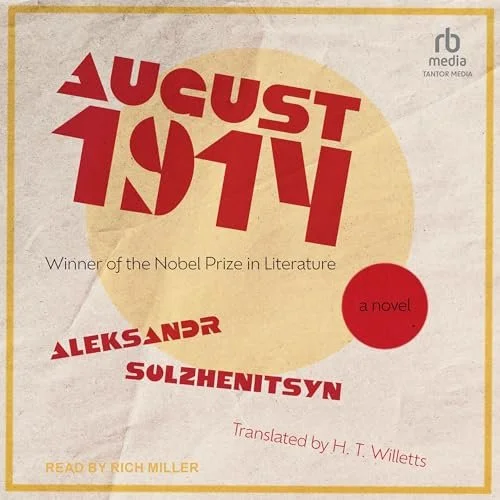
New audiobook of August 1914, narrated by Rich Miller

cover of August 1914 audiobook

Tantor Media have issued a new audiobook of August 1914, narrated by Rich Miller. Here is an excerpt from Chapter 82.

from August 1914, Chapter 82
“There were no large rooms in the building. The biggest of them would hold twenty in a pinch. There were in fact just twenty officers in the Quartermaster General’s department, but more than half as many again had gathered that morning.

Two short tables had been placed at right angles to each other. At the head of one sat the Supreme Commander, even when seated the tallest man present. Next to him—they were inseparable—was his brother. Grand Duke Pyotr Nikolaevich, dutifully taking it all in (although everybody knew that for years past he had been preoccupied with church architecture and uninterested in military matters). Next to him was their cousin, the choleric Prince Pyotr of Oldenburg (“Poppycock Pasha”). Then came the Adjutant General, Illustrious Prince Dmitri Golitsyn (master of the royal hunt in recent years). Then General Petrovo-
Solovovo, the debonair marshal of the Ryazan nobility, now a“general-in-waiting.” ”
— from August 1914, Chapter 82

Solzhenitsyn and the Engine of History

new criterion | vertical.png

An illuminating recapitulation, in February’s New Criterion, of The Red Wheel volumes which have appeared to date in English, from the eminent scholar Robert D. Kaplan. Full text here.

“For in this entire revolutionary process, what pierces most through the intelligent reader’s consciousness is the madness of crowds coupled with the romance and irresistibility of extremism, so that a minority ends up moving history. Just listen to Solzhenitsyn’s timeless words:

”For a long time now it has been dangerous to stand in the way of revolution, and risk-free to assist it. Those who have renounced all traditional Russian values, the revolutionary horde, the locusts from the abyss, vilify and blaspheme and no one dares challenge them. A left-wing newspaper can print the most subversive of articles, a left-wing speaker can deliver the most incendiary of speeches—but just try pointing out the dangers of such utterances and the whole leftist camp will raise a howl of denunciation.”

Nobody interferes with the mob, least of all the polished and oh-so-civilized intelligentsia, who see the radical Left as composed of a purer and distilled archetype of their own values, and only awake from their dreams when it is too late. For, as it is said, people who have lost faith in God believe in nothing, and they will therefore believe in anything. Richard Bernstein, a former book critic for The New York Times, in referring to campus multiculturalism, calls this larger phenomenon “the dictatorship of virtue,” something that took firm root in twentieth-century totalitarianism, in which the perfect race or system becomes the absolute destroyer of everything good. In this way Solzhenitsyn’s story is a timeless one, aptly suited for our own age.”

Tony Woodlief reviews March 1917, Book 2

The American Conservative.png

An impressive and smart review of March 1917, Book 2, also taking into account its precursors—August 1914 and October 1916, as well as Book 1 of March.

““Revolutionary truths,” Solzhenitsyn writes, “have a great quality: even hearing them with their own ears, the doomed don’t understand.” There’s a moment in the revelry, after the soldiers have all donned red, after every policeman has been shot or bayoneted, when intellectuals who called loudest for revolution realize there are no patrols to fend off drunken gangs, nor courts to repudiate armed students arresting whomever they please for “crimes against the people.” In this brave new world, rule of law has been displaced by the rule of gun-toting loudmouths. It’s too late for them, and for the millions who will be subjected to lifelong suffering because ideologically enthralled intellectuals hammered away at society’s foundation until it collapsed. After Lenin comes Stalin. He always does.”