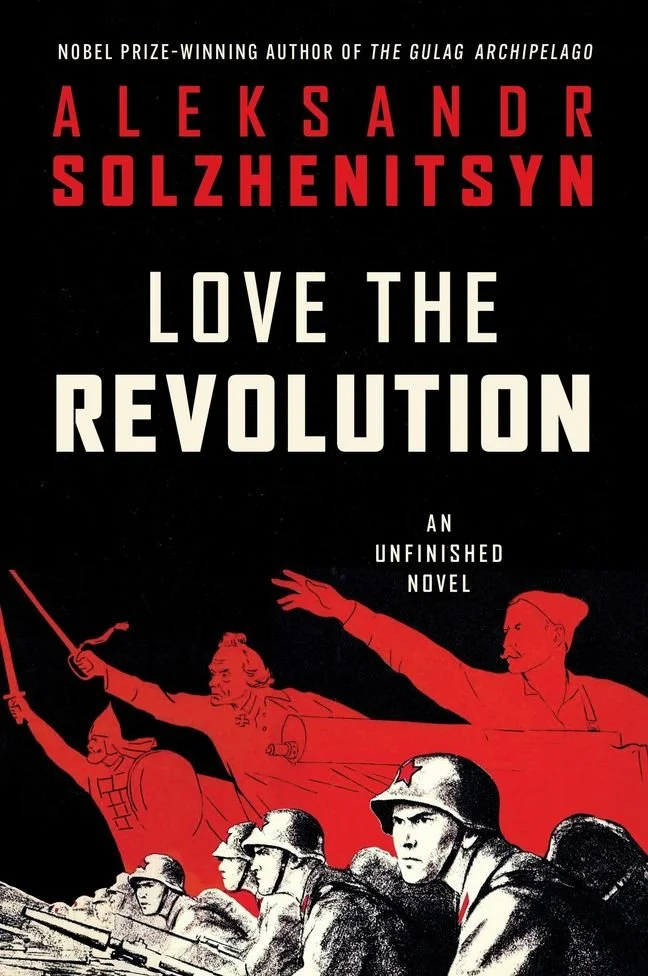
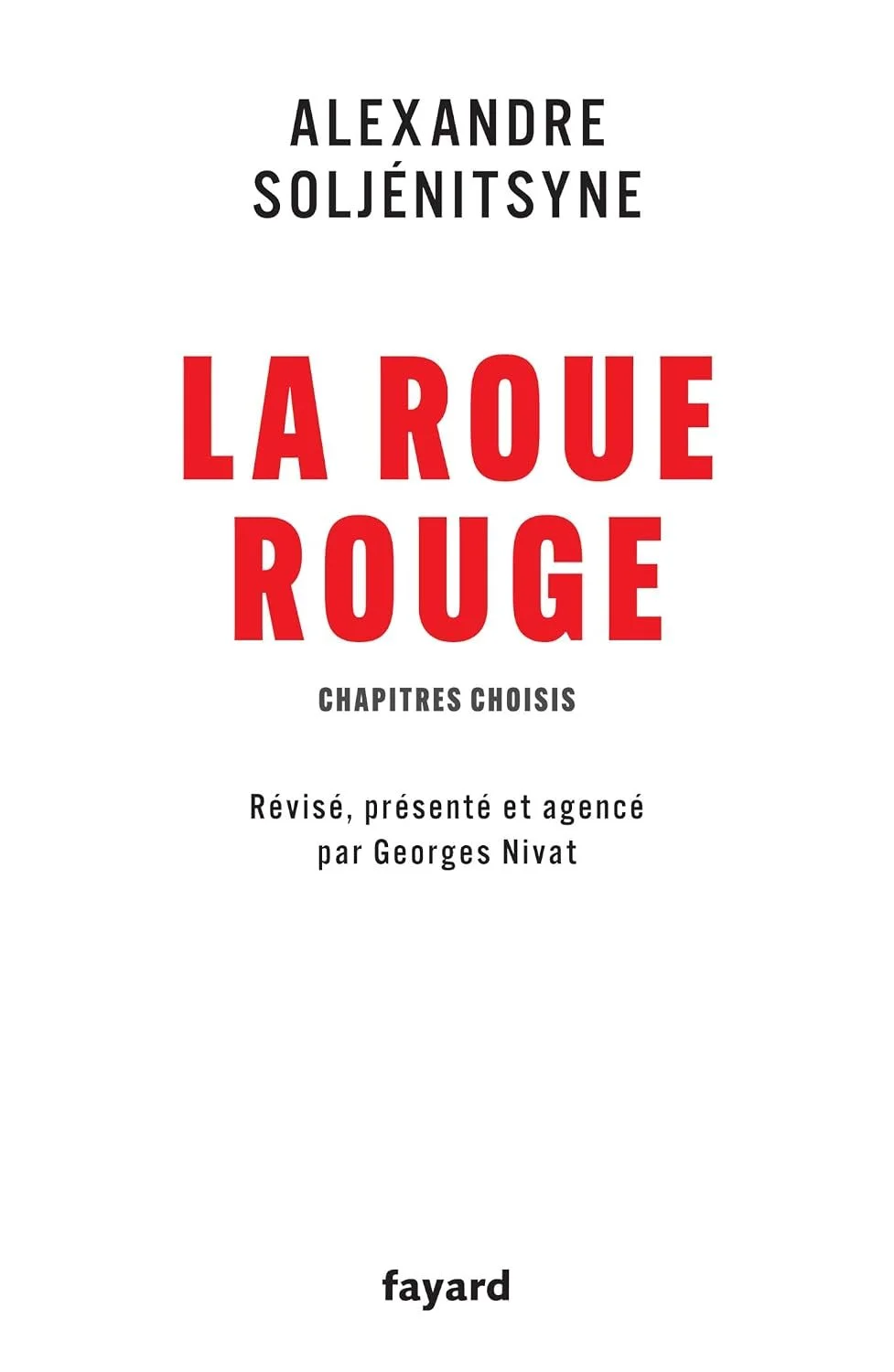
PUBLISHED TODAY: March 1917, Book 4 re-issued in paperback

Book 4 of March 1917, first published in English by Notre Dame Press two years ago, has been released today in paperback.  See a short video introducing the book here. To catch up on The Red Wheel from the beginning, read August 1914, October 1916, Book 1 of March 1917, Book 2 of March 1917, Book 3 of March 1917, then this Book 4. April 1917, Book 1 came out in hardcover in 2025. April 1917, Book 2 is due out in Autumn 2027.


Catch-up Review for Readers of The Red Wheel

Here is a very helpful “catch-up” of where things stand in The Red Wheel saga. Tom Bowden, over at Book Beat, recaps the four volumes of March 1917 and reviews April 1917, Book 1.

“The completed work stretches from August 1914 to May 1917, and is divided into four parts, or nodes as he called them, with reference to their mathematical meaning as a fundamental point of interest within a structure or network. That is, each node may be read without reference to the others, even though they appear on a timeline as part of a continuum. (Both August 1914 and November 1916 are published in English as single volumes of about 900 pages each.)

An implication of organizing the novels this way is that it suggests—and the novels repeatedly bear this out—that at almost any point during almost any single event along this timeline, events could have gone otherwise. There is nothing deterministic about the sequence of occurrences, and thus the series may be read as anti- or at least non-Marxist in outlook.”
— Tom Bowden

Russian Roulette

Dominic Green reviews March 1917, Book 4 in The Lamp.

“When he began writing the first “node” of his cycle, August 1914, in 1969, Solzhenitsyn intended to follow the story to 1922, the year in which the Bolshevik regime, having won the civil war, solidified its rule and formed the Soviet Union. Solzhenitsyn halted the cycle with April 1917 after twenty years of labor. By 1989, the Soviet Union was on its deathbed, Solzhenitsyn was suffering from angina, and his readers were losing interest. The complete—which is to say, incomplete—Red Wheel has ten volumes in the original Russian. The “whirlwind of revolution” is slowed into four nodes, each covering two or three critical weeks, and each narrated through hundreds of fragmentary chapters and dozens of real and fictional characters.”
— Dominic Green

Solzhenitsyn on Russia's Moment of Crisis

In the Wall Street Journal, Gary Saul Morson continues his series of reviews of volumes of The Red Wheel with this excellent piece on March 1917, Book 4.

“The great British historian Herbert Butterfield cautioned against the temptation to tell a neat story about historical events or discover “an unfolding logic” in them. History, he argued, is constructed “not by a line but by a labyrinthine piece of network” comprised of “strange conjunctures” with “purposes marred perhaps more than purposes achieved.” That is precisely the picture Alexander Solzhenitsyn presents in the four volumes of “March 1917,” his series of historical novels, written between 1969 and 1991, that describe the chaotic events surrounding the abdication of Czar Nicholas II and the nominal transfer of power to the Duma and its Provisional Government. An attempt to understand how Russia descended into the horrors described in Solzhenitsyn’s “The Gulag Archipelago” (1973), it demonstrates how the Bolshevik takeover could have and should have been avoided.”
— Gary Saul Morson

Video of Marian Schwartz and Daniel J. Mahoney on March 1917

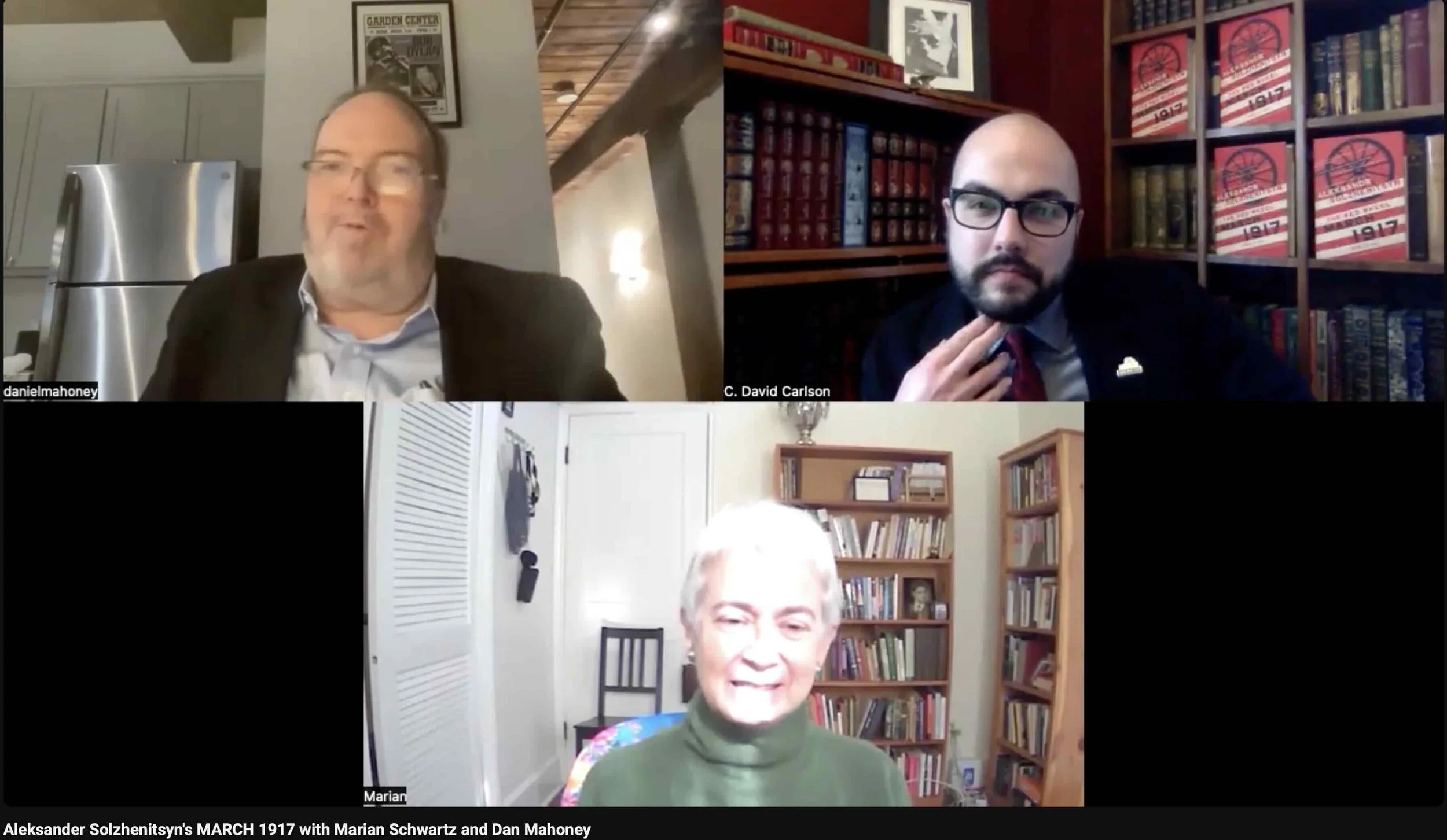
In this latest Books for Better Understanding video from Notre Dame Press, David Carlson facilitates a conversation between Marian Schwartz and Dan Mahoney about Aleksandr Solzhenitsyn's MARCH 1917: THE RED WHEEL, NODE III, all four books of which are now fully available in English for the first time. Schwartz and Mahoney discuss the historical, literary, and cultural significance of March 1917.

The Middle Path Forsworn

Over at Law and Liberty, Daniel J. Mahoney has an in-depth review of the just-published concluding Book 4 of March 1917, which is itself Node III of the four Nodes of The Red Wheel. The final section of the review essay discusses the enduring value of The Red Wheel for contemporary readers in Russia and the West alike.

“In the closing half of the volume, Lenin, still in exile in Zurich, Switzerland, becomes more and more of a looming presence. Other revolutionaries have already returned home to Russia and Lenin is eager to join them. Lenin is shrewd, daring, single-minded, fanatical, and devoid of moral scruples in the ordinary sense of the term. As with all Solzhenitsyn’s main characters, we hear Lenin’s thoughts from the inside, so to speak, even if the author has no sympathy for his machinations or the ideological fanaticism that drives them. This diversity of inner voices heightens the interest and intelligibility of the drama. The Red Wheel is in no way “monologic” even if its author is anything but neutral in the great contest between civilized order and revolutionary subversion.”
— Daniel J. Mahoney

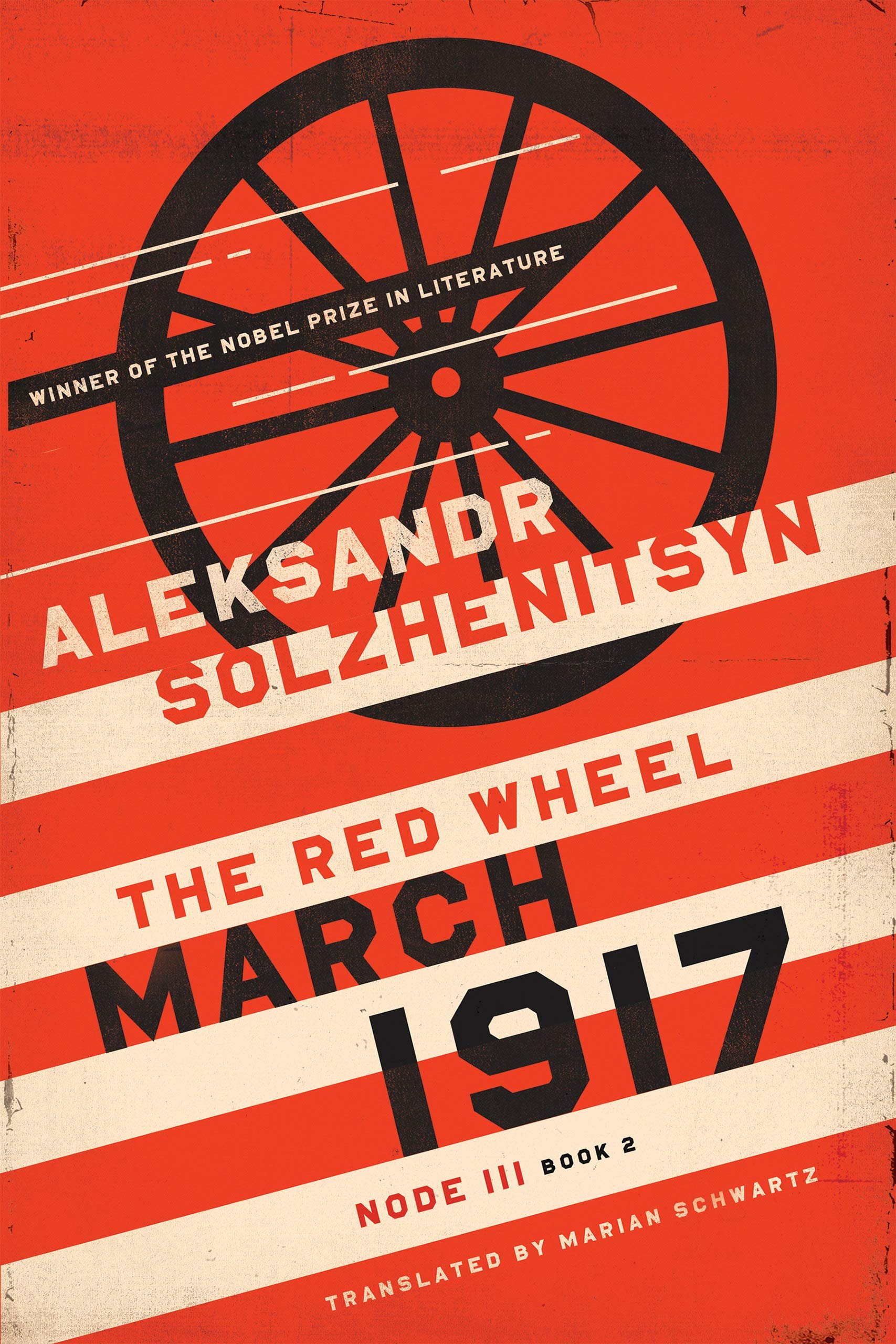
PUBLISHED TODAY: March 1917, Book 4

The Red Wheel, Node III, March 1917, Book 4 is available today for the first time in English from University of Notre Dame Press, from Amazon or wherever books are sold.

The action of Book 4 is set during March 23–31, 1917. Book 4 portrays a cast of thousands in motion and agitation as every stratum of Russian society—the army on the front lines, the countryside, the Volga merchants, the Don Cossacks, the Orthodox Church—is racked by the confusing new reality. Soldiers start to fraternize across trenches with the enemy. The Grand Duke Nikolai Nikolaevich, the emperor’s uncle, arrives at military headquarters to assume the supreme command but is promptly dismissed by the new Provisional Government. But this government, too, holds no power, for at every step it is cowed and hemmed in by a self-proclaimed and unaccountable Executive Committee acting in the name of the Soviets—councils of workers and soldiers. And the Soviets themselves are divided—on whether to call for an end to the war or for its continuation, on whether to topple the Provisional Government or to let it try to govern. Meanwhile, in Switzerland, Lenin quietly dictates his own terms to the German General Staff, setting the stage for his return to Russia.

We remind Solzhenitsyn readers of the overall sequence of the 10-book Red Wheel:
Node I: August 1914, Books 1 & 2 (Farrar, Straus & Giroux, published in one volume)
Node II: November 1916, Books 1 & 2 (Farrar, Straus & Giroux, published in one volume)
Node III: March 1917, Book 1 (University of Notre Dame Press)
Node III: March 1917, Book 2 (University of Notre Dame Press)
Node III: March 1917, Book 3 (University of Notre Dame Press)
Node III: March 1917, Book 4 (University of Notre Dame Press)
Node IV: April 1917, Book 1 (forthcoming—University of Notre Dame Press)
Node IV: April 1917, Book 2 (forthcoming—University of Notre Dame Press)

To inform readers about Solzhenitsyn’s system of “Nodes”, and also to explain the definitive term “Node” (instead of the older “Knot”), here is a portion of the Publisher’s Note that accompanies each of the Notre Dame volumes:

The English translations by H.T. Willetts of August 1914 and November 1916, published by Farrar, Straus and Giroux in 1989 and 1999, respectively, appeared as Knot I and Knot II. The present translation, in accordance with the wishes of the Solzhenitsyn estate, has chosen the term “Node” as more faithful to the author’s intent. Both terms refer, as in mathematics, to discrete points on a continuous line. In a 1983 interview with Bernard Pivot, Aleksandr Solzhenitsyn described his narrative concept as follows: “The Red Wheel is the narrative of revolution in Russia, its movement through the whirlwind of revolution. This is an immense scope of material, and . . . it would be impossible to describe this many events and this many characters over such a lengthy stretch of time. That is why I have chosen the method of nodal points, or Nodes. I select short segments of time, of two or three weeks’ duration, where the most vivid events unfold, or else where the decisive causes of future events are formed. And I describe in detail only these short segments. These are the Nodes. Through these nodal points I convey the general vector, the overall shape of this complex curve.”

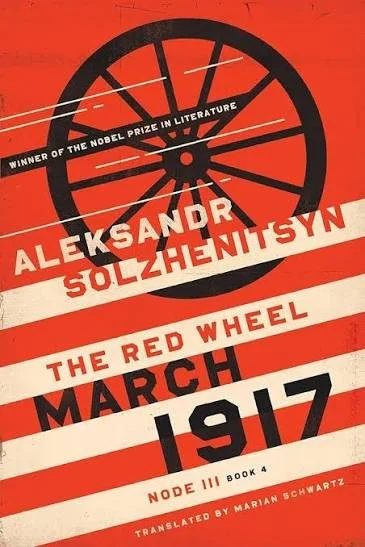
PUBLISHED TODAY: March 1917, Book 3 re-issued in paperback

Book 3 of March 1917, first published in English by Notre Dame Press three years ago, has been released today in paperback. See a short video introducing the book here. To catch up on The Red Wheel from the beginning, read August 1914, October 1916, Book 1 of March 1917, Book 2 of March 1917, then this Book 3. Book 4 is due out in autumn 2024.


Short Video Introducing Between March 1917, Book 4

Learn more about the forthcoming English publication of March 1917: The Red Wheel, Node III, Book 4, due out for the first time in English, translated by Marian Schwartz, 1 October 2023 from University of Notre Dame Press.

MARCH 1917: THE RED WHEEL, Node III, Books 1-4 by Aleksandr Solzhenitsyn Aleksandr Solzhenitsyn's The Red Wheel is a four-part series on the Russian Revolution told in the form of a historical novel. Each book representing a week in March 1917, this multivolume epic work tells the story, day by day, of the Russian Revolution itself.

PUBLISHED TODAY: March 1917, Book 2 re-issued in paperback

Book 2 of March 1917, first published in English by Notre Dame Press three years ago, has been released today in paperback. See a short video introducing the book here. To catch up on The Red Wheel from the beginning, read August 1914, October 1916, Book 1 of March 1917, then this Book 2 of March 1917. Book 3 is here, and Book 4 is due out in autumn 2024.


New audiobook of March 1917, Book 1, narrated by Daniel Henning

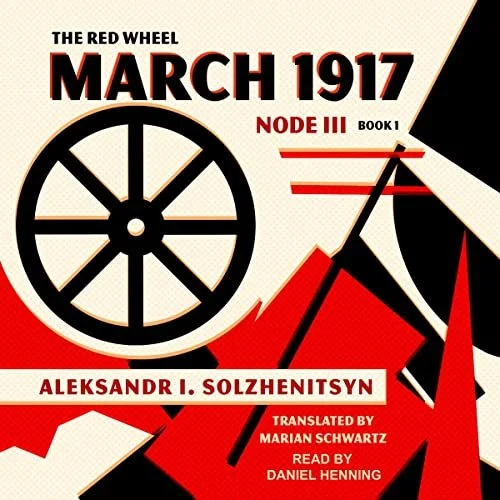
cover of March 1917, Book 1 audiobook

Tantor Audio have issued a new audiobook of March 1917, Book 1, narrated by Daniel Henning. Here is an excerpt from Chapter 1.

from March 1917, Book 1, Chapter 1
“Nikolai spent sixty-six days at Alix’s side in the contained stillness of Tsarskoye Selo, by his presence easing her immeasurable grief over her loss. (Fortunately, the winter lull at the front had permitted this absence from GHQ.)

Troubled, restless, and grief-stricken, Alix had communicated to Nikolai her sense of an impending stretch of disasters and misfortunes that would not be overcome quickly.

There was another disaster as well: the poor man’s death had drawn a line of misunderstanding between Nikolai and Alix. They had always had different views of Grigori, his essence and significance and the extent of his wisdom, but Nikolai had never insisted on this, sparing Alix’s feelings and belief. Now, though, Alix could not forgive her husband for not handing the murderers over to justice.”
— from March 1917, Book 1, Chapter 1

What Solzhenitsyn Understood

Aleksandr Solzhenitsyn; illustration by Seth

The eminent New York Review of Books features a major piece, in its current issue, by the always-insightful Gary Saul Morson, a splendid reflection on the Red Wheel and the misunderstandings that proliferated around Solzhenitsyn during his Western exile—the years of Between Two Millstones.

Read the full piece in PDF below.

“Despite its relentless focus on political events, The Red Wheel paradoxically instructs that politics is not the most important thing in life. To the contrary, the main cause of political horror is the overvaluing of politics itself. It is supremely dangerous to presume that if only the right social system could be established, life’s fundamental problems would be resolved. Like the great realist novelists of the nineteenth century, Solzhenitsyn believed that, as he stated in Rebuilding Russia,

political activity is by no means the principal mode of human life…. The more energetic the political activity in a country, the greater is the loss to spiritual life. Politics must not swallow up all of a people’s spiritual and creative energies. Beyond upholding its rights, mankind must defend its soul.”
— Quote Source

Interactive Map of the Red Wheel

The University of Notre Dame Press has announced the launch of a new interactive map of the Red Wheel, pairing especially well with Node 3 (March 1917). The map brings the story to life, allowing the reader to explore the historical landmarks and visualize the Revolution like never before. With this map, readers can view important locations from the books both as they appeared during the Revolution and how they look today with both English and Russian descriptions. Tour Mikhail Nikolaevich's palace and learn the history of Cubat's restaurant during an exploration of 1917 Petrograd and modern-day St. Petersburg.

Interact with the map at redwheelmap.org.

Aleksandr Solzhenitsyn’s masterpiece

Building on his valuable overview of those volumes of The Red Wheel published in English as of January 2021 (i.e., through March 1917, Book 2), the estimable Robert D. Kaplan continues to engage with the argument and action of Solzhenitsyn’s great work on the Russian Revolution now that Book 3 of March 1917 is out.

“But did it have to happen as it happened? Solzhenitsyn does not say it, but if the royal family had not been executed — and if a quasi-constitutional monarchy had been established — the twentieth century would have been far less bloody. Instead, the abdication and subsequent arrest of Nicholas II and his family led to a vacuum of authority. The worse the anarchy, the worse the solution. Meanwhile, Lenin, brooding in his Zurich exile, had his mind fixed on the mistakes of the Paris Commune (the insurrection that followed France’s defeat by Prussia in the war of 1870-71). As Solzhenitsyn inhabits the thoughts of Lenin, the leader of the October Revolution-yet-to-come condemns all displays of weakness and humanity. We must seize the banks. We must not be magnanimous. Don’t save people in order to re-educate them; conduct cellar executions instead: “The proletariat had to be taught pitiless mass methods!”

And so it happened thus. As each new book in the series appears in translation, Solzhenitsyn’s Red Wheel is emerging as the ultimate monument to the perils of illusion and disorder.”
— Robert D. Kaplan

The Revolutionary Chaos of March 1917

Lee Congdon has a fine review of March 1917, Book 3 in the latest issue of National Review.

“But perhaps resistance would have been futile. Not so, according to Solzhenitsyn. The revolutionaries were largely untrained and poorly armed. Because of the relative calm then existing at the front, up to a million soldiers would have been available to retake Petrograd. Thirty thousand would have been more than enough, but the Supreme Command thought only of surrender. “It was a panop­­ticum of weak and incapable men.” Those words reflect Solzhenitsyn’s view that history is radically contingent; nothing is inevitable. The revolution resulted from the action (or inaction) of men and women who could have chosen different paths.

Solzhenitsyn’s highly critical account of the March Revolution is of a piece with his hostile attitude toward all revolutions. He was not opposed to change; quite the contrary. He believed strongly and wrote often that czarist Russia had been in need of a reform program of the kind advanced by Prime Minister Pyotr Stolypin. Had that great leader not been assassinated in 1911, and had the czar not decided for war, Russia would almost certainly have been spared the revolution to come. In the fall of 1993, Solzhenitsyn gave an address in Les Lucs-sur-Boulogne commemorating the bicentennial of the counterrevolutionary Vendée Uprising. He told those gathered that he would not wish a “great revolution” upon any nation. France, he said, had a Thermidorian reaction that overthrew Robespierre, but the revolution in Russia “was not restrained by any Thermidor as it drove our people on the straight path to a bitter end, to an abyss, to the depths of ruin.” Those words, and Solzhenitsyn’s riveting account of the March Revolution, should give Americans pause.”
— Lee Congdon

March-3 reviewed in Asian Review

Francis P. Sempa reviews the newly released March-3 in the Asian Review of Books.

“When historians and writers of historical fiction look back on events and developments they can sometimes portray them with more understanding and order than they deserve. The best historians and novelists—and Solzhenitsyn was first and foremost a novelist—narrate history through the eyes and ears of the participants who don’t know the outcome of the events they are observing and participating in. In March 1917, Solzhenitsyn presents events through the characters’ perspectives and perceptions at the time, not in hindsight or years afterward, lending authenticity to his narrative by putting us in the room (so to speak) with the statesmen, officers, soldiers and citizens who experienced the chaos of war and revolution.”
— Francis P. Sempa

Marissa Moss reviews March-3

NY Journal of Books.png

Marissa Moss reviews March 1917, Book 3 at the New York Journal of Books.

“This kind of writing shows Solzhenitsyn’s impressive novelistic skills at creating characters, including those based on real people. This mix of styles makes for gripping reading, placing us in the midst of this whirlwind of confusion. Revolutions aren’t simple and there isn’t a single person in charge. By revealing the history through a range of different characters’ experiences, the events feel personal, many small “nodes” converging into a momentous wave.”
— Marissa Moss

Six days that sealed Russia’s fate

Law & Liberty.png

The first review of the newly-published March 1917, Book 3 (“March-3”) is already out! A comprehensive piece by Dan Mahoney, summing up all the key action and situation. The book is available now, both as hardcover and as e-book, wherever books are sold, including on the publisher’s website and on Amazon.

“The reader once again finds himself or herself in medias res, caught up in dramatic revolutionary events which have now spread out from Petrograd the capital to the whole of the Russian empire. Russian “society,” as it had called itself for more than a half century to distinguish itself from an allegedly repellent Tsarist state order, is at once hypnotized and inebriated by a revolutionary spirit that sees no good in the passing order, confuses freedom with the absence of all hierarchy, authority, and order, and that above all sees no enemies to the Left. If wild and reckless street scenes dominated the first two books of March 1917, the revolutionary self-enslavement of civil society is the dominant note in the third book which covers the days from March 16th to March 22nd, 1917, although the streets do remain restless and chaotic. What Freud called “the reality principle” is almost nowhere to be found in the consciousness of the principal actors under discussion. Revolutionary inebriation abounds.
”
— Daniel J. Mahoney

Published Today: March 1917, Book 3

March-3 cover.png

The Red Wheel, Node III, March 1917, Book 3 is available today for the first time in English from University of Notre Dame Press, from Amazon, or wherever books are sold.

The action of Book 3 (out of four) is set during March 16–22, 1917. In Book 3, the Romanov dynasty ends and the revolution starts to roll out from Petrograd toward Moscow and the Russian provinces. The dethroned Emperor Nikolai II makes his farewell to the Army and is kept under guard with his family. In Petrograd, the Provisional Government and the Soviet of Workers’ and Soldiers’ Deputies continue to exercise power in parallel. The war hero Lavr Kornilov is appointed military chief of Petrograd. But the Soviet’s “Order No. 1” reaches every soldier, undermining the officer corps and shaking the Army to its foundations. Many officers, including the head of the Baltic Fleet, the progressive Admiral Nepenin, are murdered. Black Sea Fleet Admiral Kolchak holds the revolution at bay; meanwhile, Grand Duke Nikolai Nikolaevich, the emperor’s uncle, makes his way to military headquarters, naïvely thinking he will be allowed to take the Supreme Command.

We remind Solzhenitsyn readers of the overall sequence of the 10-volume Red Wheel:
Node I: August 1914, Books 1 & 2 (Farrar, Straus & Giroux, published in one volume)
Node II: November 1916, Books 1 & 2 (Farrar, Straus & Giroux, published in one volume)
Node III: March 1917, Book 1 (University of Notre Dame Press)
Node III: March 1917, Book 2 (University of Notre Dame Press)
Node III: March 1917, Book 3 (University of Notre Dame Press)
Node III: March 1917, Book 4 (forthcoming—University of Notre Dame Press)
Node IV: April 1917, Book 1 (forthcoming—University of Notre Dame Press)
Node IV: April 1917, Book 2 (forthcoming—University of Notre Dame Press)

To inform readers about Solzhenitsyn’s system of “Nodes”, and also to explain the definitive term “Node” (instead of the older “Knot”), here is a portion of the Publisher’s Note that accompanies each of the Notre Dame volumes:

The English translations by H.T. Willetts of August 1914 and November 1916, published by Farrar, Straus and Giroux in 1989 and 1999, respectively, appeared as Knot I and Knot II. The present translation, in accordance with the wishes of the Solzhenitsyn estate, has chosen the term “Node” as more faithful to the author’s intent. Both terms refer, as in mathematics, to discrete points on a continuous line. In a 1983 interview with Bernard Pivot, Aleksandr Solzhenitsyn described his narrative concept as follows: “The Red Wheel is the narrative of revolution in Russia, its movement through the whirlwind of revolution. This is an immense scope of material, and . . . it would be impossible to describe this many events and this many characters over such a lengthy stretch of time. That is why I have chosen the method of nodal points, or Nodes. I select short segments of time, of two or three weeks’ duration, where the most vivid events unfold, or else where the decisive causes of future events are formed. And I describe in detail only these short segments. These are the Nodes. Through these nodal points I convey the general vector, the overall shape of this complex curve.”

Produced for Inspection

Concluding today, National Review publishes three excerpts in three days from Solzhenitsyn’s about-to-be-released , The Red Wheel, Node III, March 1917, Book 3, translated by Marian Schwartz, available Friday, for the first time in English, from University of Notre Dame Press, from Amazon, or wherever books are sold. (For Tuesday’s excerpt, go here. For yesterday’s, here.) Today’s selection—the closing chapter of Book 3—shows Emperor Nikolai II, just hours after his careless abdication on March 15, 1917, preoccupied with the health of his children rather than the fate of his abandoned people. He is roused by his Empress just enough to be force-paraded in front of a “Soviet” commissar whose overt malice portends the ruin to come.

Click here to read the full chapter at National Review.

“Starker yet were his snake eyes, they burned with hatred. The commissar’s face twisted, and he was shaking feverishly.
In front of this vivid appearance of malice, the Emperor stopped, woke up—and felt it. On his face, puffy with weariness, the meaning became apparent—as did his exhaustion.
He swayed a little from foot to foot. He jerked one shoulder. And was about to turn and go—but couldn’t, out of politeness, not nod to the group in parting.
He nodded.
And walked away, his step unsteady—but rather than go very far forward, in the direction he had been heading, he went back to from whence he had come.”
— March 1917, Book 3, Chapter 531