PUBLISHED TODAY: March 1917, Book 4
/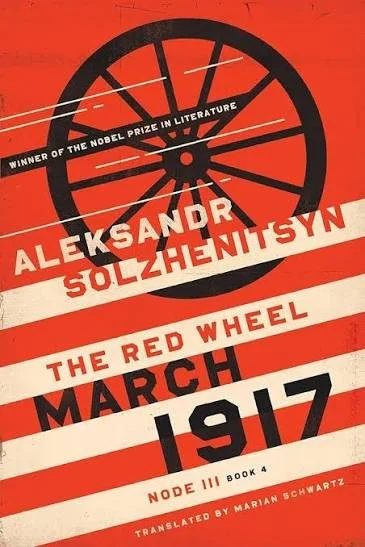
The Red Wheel, Node III, March 1917, Book 4 is available today for the first time in English from University of Notre Dame Press, from Amazon or wherever books are sold.
The action of Book 4 is set during March 23–31, 1917. Book 4 portrays a cast of thousands in motion and agitation as every stratum of Russian society—the army on the front lines, the countryside, the Volga merchants, the Don Cossacks, the Orthodox Church—is racked by the confusing new reality. Soldiers start to fraternize across trenches with the enemy. The Grand Duke Nikolai Nikolaevich, the emperor’s uncle, arrives at military headquarters to assume the supreme command but is promptly dismissed by the new Provisional Government. But this government, too, holds no power, for at every step it is cowed and hemmed in by a self-proclaimed and unaccountable Executive Committee acting in the name of the Soviets—councils of workers and soldiers. And the Soviets themselves are divided—on whether to call for an end to the war or for its continuation, on whether to topple the Provisional Government or to let it try to govern. Meanwhile, in Switzerland, Lenin quietly dictates his own terms to the German General Staff, setting the stage for his return to Russia.
We remind Solzhenitsyn readers of the overall sequence of the 10-book Red Wheel:
Node I: August 1914, Books 1 & 2 (Farrar, Straus & Giroux, published in one volume)
Node II: November 1916, Books 1 & 2 (Farrar, Straus & Giroux, published in one volume)
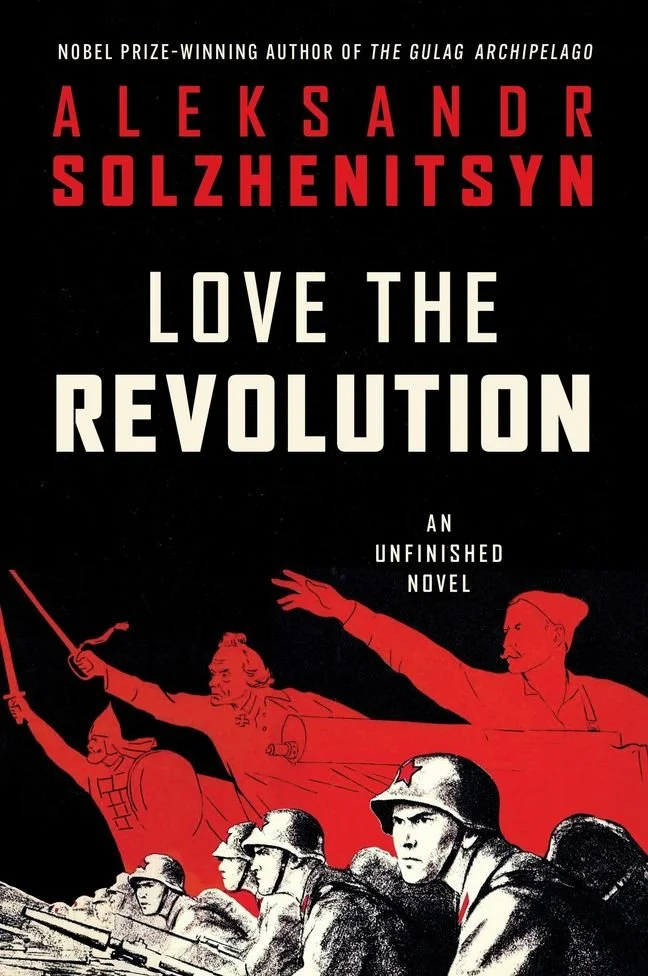
Node III: March 1917, Book 1 (University of Notre Dame Press)
Node III: March 1917, Book 2 (University of Notre Dame Press)
Node III: March 1917, Book 3 (University of Notre Dame Press)
Node III: March 1917, Book 4 (University of Notre Dame Press)
Node IV: April 1917, Book 1 (forthcoming—University of Notre Dame Press)
Node IV: April 1917, Book 2 (forthcoming—University of Notre Dame Press)
To inform readers about Solzhenitsyn’s system of “Nodes”, and also to explain the definitive term “Node” (instead of the older “Knot”), here is a portion of the Publisher’s Note that accompanies each of the Notre Dame volumes:
The English translations by H.T. Willetts of August 1914 and November 1916, published by Farrar, Straus and Giroux in 1989 and 1999, respectively, appeared as Knot I and Knot II. The present translation, in accordance with the wishes of the Solzhenitsyn estate, has chosen the term “Node” as more faithful to the author’s intent. Both terms refer, as in mathematics, to discrete points on a continuous line. In a 1983 interview with Bernard Pivot, Aleksandr Solzhenitsyn described his narrative concept as follows: “The Red Wheel is the narrative of revolution in Russia, its movement through the whirlwind of revolution. This is an immense scope of material, and . . . it would be impossible to describe this many events and this many characters over such a lengthy stretch of time. That is why I have chosen the method of nodal points, or Nodes. I select short segments of time, of two or three weeks’ duration, where the most vivid events unfold, or else where the decisive causes of future events are formed. And I describe in detail only these short segments. These are the Nodes. Through these nodal points I convey the general vector, the overall shape of this complex curve.”