FAKE QUOTE FALSELY ATTRIBUTED TO SOLZHENITSYN

A malicious, entirely fake quote attributed to Solzhenitsyn has been making the rounds of the internet. Some versions are longer, some are shorter, but all are entirely fake, whether or not the people posting and re-posting them are aware of this. Here it is:

You must understand. The leading Bolsheviks who took over Russia were not Russians. They hated Russians! They hated Christians! Driven by ethnic hatred they tortured & slaughtered millions of Russians without a shred of human remorse. The October Revolution was not what you call in America the ‘Russian Revolution’. It was an invasion & conquest over the Russian people. More of my countrymen suffered horrific crimes at the blood-stained hands than any people, or nation ever suffered in the entirety of human history. It cannot be understated! Bolshevism was the greatest human slaughter of all time. The fact that most of the world is ignorant of this reality is proof that the global media itself is in the hands of the perpetrators. We cannot state that all Jews are Bolsheviks, but without Jews there would have been no Bolshevism. For a Jew, nothing is more insulting than the truth. The blood-maddened Jewish terrorists murdered 66 million in Russia from 1918 to 1957.

We challenge anyone to demonstrate where, exactly, Solzhenitsyn purportedly writes any of this; please indicate work title, chapter name, and page number. Knock yourselves out, but you will never be able to—because this passage does not exist in his writings. What makes a fake like this especially damaging is that it takes elements of Solzhenitsyn’s thought and re-packages them in a veneer of plausibility. (After all, Solzhenitsyn WAS an implacable enemy of Bolshevism, right?… And he DID mention the figure of 66 million casualties in his Gulag Archipelago?…) But not a single phrase in this fake is an actual quote, nor is the overall idea faithful in the least to Solzhenitsyn’s worldview. And most reprehensible of all is the attribution to Solzhenitsyn of the tired anti-Semitic canard that it was “the Jews” who were responsible for the Russian Revolution. Without minimizing Jewish involvement in the Revolution, Solzhenitsyn, in Two Hundred Years Together, nonetheless sums up his overall conclusion about that complex topic with words that unambiguously contradict the fake quote:

During my many years of in-depth work on the February Revolution it fell to me to make out its essence and understand the role played in it by Jews. I have concluded for myself, and can reiterate now, that, no, the February Revolution was not something the Jews did to the Russians—it was undoubtedly the handiwork of Russians themselves, as I believe I have amply demonstrated in The Red Wheel.
— Solzhenitsyn, Two Hundred Years Together, chapter 13

Please help spread the word by making your voice heard anywhere you see this fake, or ones like it, and feel free to refer back to this post.
Solzhenitsyn’s “Literary Collection” to be published in English

We are pleased to announce that a curated collection of twelve Solzhenitsyn essays (from the several dozen that make up his self-styled Literary Collection), translated by Leo Shtutin and edited by Richard Tempest, is slated to appear in English from Cherry Orchard Books (an imprint of Academic Studies Press) in Spring 2027 under the title Essays on Russian Literature. For more information, see the publisher’s website.

Aleksandr Solzhenitsyn was perhaps the foremost moral witness to Soviet totalitarianism, and the last great representative of the nineteenth-century Russian ethical tradition. This volume is a collection of Solzhenitsyn’s literary criticism, engaging with the Russian canon across decades and centuries, from Lermontov and Chekhov to Akhmatova and Brodsky. The creator of One Day in the Life of Ivan DenisovichCancer Ward and The Gulag Archipelago proves here that he could discern the presence of kindness or beauty in a work by an artist whose artistic practices are by and large alien to his own; or even, in his view, objectionable. Insightful, aphoristic, and occasionally provocative, these essays explore dozens of imagined worlds, crafted by some of Russia’s greatest writers and poets—and Solzhenitsyn's inimitable way of expressing himself, with lively, witty, sometimes waspish turns of phrase, is very much at the fore. 

Solzhenitsyn Reading Group at Harvard

Harvard’s Abigail Adams Institute has announced a Solzhenitsyn summer reading group, to focus on five of the author’s most probing speeches and essays.

I cannot think of any more worthwhile study for any student on any campus today than to go carefully through all the writings and discourses of Aleksandr Solzhenitsyn.
— Malcolm Muggeridge

Update on The Red Wheel in English

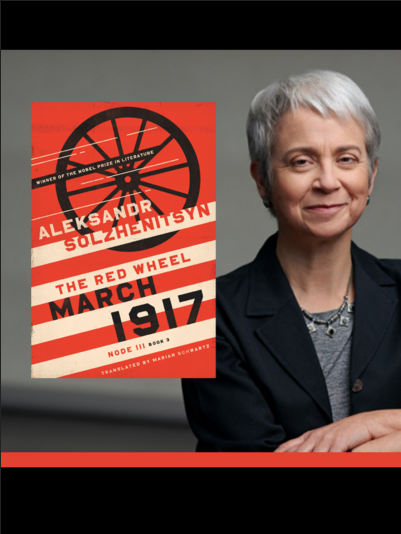
Progress in completing the publication of The Red Wheel—Solzhenitsyn’s epic of the Russian Revolution—is proceeding slowly but surely. Readers are reminded that there was an unfortunate, tremendous lull after the 1989 publication of Node I and the 1999 publication of Node II. Once a new translator (Marian Schwartz) and publisher (University of Notre Dame Press) took on the task to bring out the remainder of the book in English, a new book of Node III (March 1917, itself consisting of four books) has come out every other autumn since 2017, i.e. in 2017, 2019, 2021. Book 4 is slated for October 2024, completing Node III, and thereafter the two books of Node IV (April 1917) will follow in due course.

We remind Solzhenitsyn readers of the overall sequence of the 10-volume Red Wheel:

Aza Alibekovna Takho-Godi Awarded Solzhenitsyn Literature Prize

The 2022 Aleksandr Solzhenitsyn Prize in Literature has been awarded to legendary philologist Aza Alibekovna Takho-Godi, who has just celebrated her 100th (!) birthday. Natalia Solzhenitsyn, who announced the prize in Moscow on behalf of the jury, remarked that “like for Plato, your work became more than a virtuous habit, but your very life”.

Remembering Mike Nicholson

Michael A. (“Mike”) Nicholson

1943–2022

We mourn the sudden death last Friday of our dear friend and colleague, Mike Nicholson. Dr. Michael A. Nicholson was Tutorial fellow in Russian at University College, Oxford, from 1987 to 2011 and one of the world’s leading experts on Solzhenitsyn. Mike was possessed of a sparkling, vivacious wit, jolly good humor, but also quite capable of biting sarcasm (when called for). A great and important scholar of Solzhenitsyn, and a lover of truth. Each of us enjoyed his company immensely on those happy occasions when we could be together with him.

We have compiled a partial list of Mike’s work on Solzhenitsyn:

Tributes to Mike are here and here. Tomorrow’s funeral service will take place in the College Chapel, Oxford, at 2 o’clock p.m. and can also be livestreamed here.

Rest in peace, gentle friend.

Solzhenitsyn Was Right

An interesting reflection by Rabbi Jeremy Rosen over at J-Wire on Solzhenitsyn and his legacy.

He strongly objected to the mischaracterization of his views by the same western intellectual and journalistic circles that had previously praised his courage in criticizing the USSR. But turned against him when he began to dismiss the vapid, armchair intellectual hypocrisy of Western societies which failed to offer viable moral alternatives. He felt alienated by the disregard and rejection of a serious spiritual dimension in American life. He spoke out against the way most of the media in the West, distorted facts just as much as the Soviet censors had and still do.
— Rabbi Jeremy Rosen

Marian Schwartz on Translating The Red Wheel

Prolific translator Marian Schwartz talks about translating Russian literature, and notably March 1917, into English.

Marian Schwartz, translator of Aleksandr Solzhenitsyn’s "The Red Wheel: March 1917"

Marian Schwartz, translator of Aleksandr Solzhenitsyn’s "The Red Wheel: March 1917"

Schwartz describes her commitment to translating Russian writers and the importance of their publication in the United States, “I came of age during the Cold War gripped by the injustice and brutality of the Soviet Union. In the dark 1970s, no author had a bigger impact on the West’s perception of that reality than Aleksandr Solzhenitsyn, beginning with his soul-shattering novella One Day in the Life of Ivan Denisovich, and culminating in 1974 with the publication in English of his monumental The Gulag Archipelago. Both those books hit me hard just as I was learning Russian and falling in love with one of the world’s great literatures, many of whose writers had suffered and were then suffering a hideous fate. In graduate school, I began thinking about translation. I felt a natural impulse to share this important and beautiful writing with my fellow English speakers.”

Short Video Introducing Between March 1917, Book 3

Learn more about the forthcoming English publication of March 1917: The Red Wheel, Node III, Book 3, due out for the first time in English, translated by Marian Schwartz, 15 October from University of Notre Dame Press.

March 1917: The Red Wheel, Node III, Book 3 by Aleksandr Solzhenitsyn. Available October 15, 2021, wherever books are sold. Published by University of Notre Dame Press at undpress.nd.edu

"Why I’m Leaving Mumford & Sons"

Winston Marshall photo.jpg

A couple of days ago a fascinating open letter was posted by a musician, Winston Marshall, leaving a world-famous band (Mumford and Sons) not out of fearful deference to a censorious Twitter mob, but out of fidelity to conscience and his own moral integrity.  And the role of Solzhenitsyn in informing his decision is striking—and encouraging. In his open letter, Mr Marshall quotes Solzhenitsyn twice to great effect, especially the remarkable peroration of “Live Not by Lies!”

So why leave the band?
On the eve of his leaving to the West, Solzhenitsyn published an essay titled ‘Live Not By Lies’. I have read it many times now since the incident at the start of March. It still profoundly stirs me.

“And he who is not sufficiently courageous to defend his soul — don’t let him be proud of his ‘progressive’ views, and don’t let him boast that he is an academician or a people’s artist, a distinguished figure or a general. Let him say to himself: I am a part of the herd and a coward. It’s all the same to me as long as I’m fed and kept warm.”

For me to speak about what I’ve learnt to be such a controversial issue will inevitably bring my bandmates more trouble. My love, loyalty and accountability to them cannot permit that. I could remain and continue to self-censor but it will erode my sense of integrity. Gnaw my conscience. I’ve already felt that beginning.
The only way forward for me is to leave the band. I hope in distancing myself from them I am able to speak my mind without them suffering the consequences. I leave with love in my heart and I wish those three boys nothing but the best. I have no doubt that their stars will shine long into the future. I will continue my work with Hong Kong Link Up and I look forward to new creative projects as well as speaking and writing on a variety of issues, challenging as they may be.
— Winston Marshall

Nobel archives reveal judges’ safety fears for Solzhenitsyn

Guardian.png
Newly opened archives at the Swedish Academy have revealed the depth of concern among Nobel judges for the consequences awaiting Aleksandr Solzhenitsyn if the dissident Soviet writer were awarded the prize for literature in 1970.

The author of One Day in the Life of Ivan Denisovich, who revealed the horrors of Stalin’s gulags in his writings and was eventually exiled by the Soviet Union, was named the Nobel laureate that year, lauded by the committee for “the ethical force with which he has pursued the indispensable traditions of Russian literature”.

But archives at the Swedish Academy, which are sealed for 50 years after each laureate is named, have revealed the fierce debate among the judges over what a win might mean for Solzhenitsyn.

[Read on at the Guardian website]

New Exhibit Marks 50th anniversary of Solzhenitsyn's Nobel Prize

Moscow’s House of Russian Culture Abroad has opened a new exhibit, “Word of Truth”, marking the 50th anniversary (1970-2020) of Solzhenitsyn being awarded the Nobel Prize in Literature. The opening of the exhibit had been delayed on account of the coronavirus pandemic. Here is a news item from Russian TV about the opening.

Live Not by Lies

10.11┆  “The man who is for the moment the most famous person in the western world” (C. Ogden) [=7.5].jpg

On this New Year’s Day, we are pleased to present to our readers the complete text of Solzhenitsyn’s seminal 1974 essay, Live Not by Lies, in the definitive translation by Yermolai Solzhenitsyn, also found in the Solzhenitsyn Reader. Live Not by Lies—a worthy resolution for this, or any other, New Year.

Yes, at first it will not be fair. Someone will have to temporarily lose his job. For the young who seek to live by truth, this will at first severely complicate life, for their tests and quizzes, too, are stuffed with lies, and so choices will have to be made. But there is no loophole left for anyone who seeks to be honest: Not even for a day, not even in the safest technical occupations can he avoid even a single one of the listed choices—to be made in favor of either truth or lies, in favor of spiritual independence or spiritual servility. And as for him who lacks the courage to defend even his own soul: Let him not brag of his progressive views, boast of his status as an academician or a recognized artist, a distinguished citizen or general. Let him say to himself plainly: I am cattle, I am a coward, I seek only warmth and to eat my fill.

Russia and the USSR: Solzhenitsyn Knew the Difference

Wall Street Journal.png

In an op-ed in today’s Wall Street Journal, Solzhenitsyn’s son, the conductor Ignat Solzhenitsyn, examines the “historical roots of Russian-Western mistrust” through the lens of his father’s ruminations on these questions, especially in the crucial Chapter 6, “Russian Pain”, which opens the forthcoming Book 2 of Between Two Millstones.

After the fall of communism, Solzhenitsyn’s call for repentance, for a historical reckoning on the model of Germany’s post-Nazi Vergangenheitsbewältigung, went unheeded. And so official government support for memorials of communist repression and the incorporation of “The Gulag Archipelago” into high-school curricula paradoxically coexists in some quarters today with a noxious strain of thought that Joseph Stalin —the chief butcher of Russians—was a Russian patriot, while Solzhenitsyn—the chief enemy of Russia’s oppressors—was a traitor.

No wonder, then, that the West has blurred any meaningful distinction between the totalitarian jackboot of the U.S.S.R. and the soft authoritarianism of a comparatively free Russia, and confused “Russian” and “Soviet,” misunderstanding three centuries of Russian history and the antinational essence of communism. “ ‘Russian’ is to ‘Soviet’ as ‘man’ is to ‘disease,’ ” wrote Solzhenitsyn. An unintended consequence: the unprecedented Russian consensus of liberal society and illiberal government, who agree on little, except that the West won’t like Russia no matter what she does.

If Western policy makers’ objective remains to bring Russia into the community of free nations, they might heed Solzhenitsyn’s plea and engage with Russia equitably, according to the virtues or failings of current policy, rather than judge her reflexively by a fictitious, maleficent historical narrative that bars any path forward.