When Solzhenitsyn visited the Hoover Institution at Stanford

Screen Shot 2019-12-28 at 14.32.35.png

A lovely recounting by Bertrand Patenaude, in the Summer issue of Hoover Digest, of Solzhenitsyn’s time spent in the Hoover archives in 1975 and 1976. Solzhenitsyn himself considered the Hoover collections hugely valuable, both for Russian history in general, and for his own specific research into the Revolution.

For forty years I had been preparing to write about the Revolution in Russia—1976 being forty years from my initial conception of the book—but it was only now at the Hoover Institution that I encountered such an unexpected volume and scope of material that I could leaf through and drink in. It was only now that I truly came to see it all, and seeing it caused a shift in my mind I did not expect. . . . Encountering the materials from the Hoover Institution, I was overwhelmed by these tangible fragments of history from the days of the February Revolution and the period leading up to it. . . . Without this towering, growing heap of living material from those years, how could I have ever imagined that it went like this?
— - from Between Two Millstones, Book 1, Chapter 4, "At Five Brooks"

Solzhenitsyn on the Future of Russia

Screen Shot 2019-12-29 at 18.38.42.png

Will Morrisey has posted an extensive and careful recapitulation of two of Solzhenitsyn’s essays on the future of Russia: Aleksandr Solzhenitsyn: Rebuilding Russia: Reflections and Tentative Proposals. Alexis Klimoff translation. New York: Farrar, Straus, and Giroux, 1991; and Aleksandr Solzhenitsyn: The Russian Question at the End of the Twentieth Century. Yermolai Solzhenitsyn translation. New York: Farrar, Straus and Giroux, 1995.

These two essays might be said to be part of a quartet of pieces examining Russia’s place in the world and potential paths to the future:

  • Letter to the Soviet Leaders (1973)

  • Rebuilding Russia (1990)

  • The Russian Question at the End of the Twentieth Century (1994)

  • Russia in Collapse (1998)

Learn more here.

New audiobook of abridged Gulag Archipelago, read by author's son

cover of new audiobook

cover of new audiobook

Our friends at Vintage/Penguin have issued a brand-new audiobook of The Gulag Archipelago (abridged version), read by the author’s middle son, Ignat Solzhenitsyn. For the time being, it is only available in the UK/Commonwealth countries, but is scheduled to come to the US in 2020. (If you prefer paperback, go here. For the full 3-volume set, go here.) Here is an excerpt from Ignat Solzhenitsyn’s reading—from Part 1, Chapter 4, “The Bluecaps”.

Physics is aware of phenomena which occur only at threshold magnitudes, which do not exist at all until a certain threshold encoded by and known to nature has been crossed. No matter how intense a yellow light you shine on a lithium sample, it will not emit electrons. But as soon as a weak bluish light begins to glow, it does emit them. (The threshold of the photoelectric effect has been crossed.) You can cool oxygen to 100 degrees below zero Centigrade and exert as much pressure as you want; it does not yield, but remains a gas. But as soon as minus 183 degrees is reached, it liquefies and begins to flow.

Evidently evildoing also has a threshold magnitude. Yes, a human being hesitates and bobs back and forth between good and evil all his life. He slips, falls back, clambers up, repents, things begin to darken again. But just so long as the threshold of evildoing is not crossed, the possibility of returning remains, and he himself is still within reach of our hope. But when, through the density of evil actions, the result either of their own extreme degree or of the absoluteness of his power, he suddenly crosses that threshold, he has left humanity behind, without, perhaps, the possibility of return .
— from The Gulag Archipelago, Part I, Chapter 4, "The Bluecaps"

Hancock on Solzhenitsyn and morality in politics

Screen Shot 2019-12-28 at 10.42.37.png

In a recent post, Ralph Hancock writes about Solzhenitsyn, morality in politics, and natural law.

In his 1993 speech to the International Academy of Philosophy in Liechtenstein, Alexandr Solzhenitsyn argues that, under the spell of the notion of “Progress,” we moderns have succumbed to the illusion that more is always better. This illusion has caused us to lose our “moral compass” and has made us oblivious to “something pure, elevated, and fragile;” that is, to the question of purpose. To recover some sense of purpose requires listening to the voice of “conscience,” a voice that directly contradicts the false promise of boundless progress by counseling above all “self-limitation.” This fundamental moral disposition of self-limitation is inseparable from “the awareness of a Whole and Higher Authority above us,” from an attitude of “humility before this entity.”
— Ralph Hancock

"Politics and the Soul" in Solzhenitsyn

Screen Shot 2019-12-28 at 10.36.11.png

Just posted, for the Spring issue of Modern Age: a probing essay by Daniel J. Mahoney on “politics and the soul” in Solzhenitsyn’s writings.

As “The Soul and Barbed Wire” demonstrates above all, The Gulag Archipelago “is about the ascent of the human spirit, about its struggle with evil,” to quote Natalia Solzhenitsyn yet again. The two spiritual possibilities, the ascent of the human soul and the struggle with evil, are inseparable for Solzhenitsyn. He is not a Stoic sage who upholds self-contained “apathy,” a spiritual serenity independent of all external circumstances. That is surely inhuman and un-Christian. As we shall see, the great Russian writer believes that radical evil must be confronted, with force if necessary, in order to defend the liberty and the dignity of the human person. In his historical novel cycle The Red Wheel and elsewhere, he contests Tolstoy’s pacifism, which conflates love with sentimentality and abandons the weak and innocent to the degradation of inhuman tyranny. Solzhenitsyn never opposed military service and honored those who served their country (but not those who served Communist ideology).
As we rapidly move along in the twenty-first century, Solzhenitsyn, chronicler of the fate of the soul under both ideological despotism and, increasingly, a soft and relativistic democracy, very much remains our contemporary: a true friend of “liberty and human dignity,” as Tocqueville put it, and a partisan of the human soul imparted to us by a just and merciful God. His courage remains an inspiration for all. While fearlessly slaying the dragon of ideology and ideological despotism, he taught us deep and enduring truths about the drama of good and evil in the human soul. He thus remains our permanent contemporary.

Claremont Review on Between Two Millstones, Book 1

Screen Shot 2019-12-28 at 10.24.30.png

A thoughful review of Between Two Millstones, Book 1 by James Pontuso for the Claremont Review of Books.

Far from being a political extremist, Solzhenitsyn showed extraordinary prescience when analyzing what later would be called the post-Communist world. He predicted that Sakharov’s dream of establishing a peaceful global community was not feasible and that globalization would eventually create nationalist movements. He worried that the collapse of Communism would rekindle ethnic hatreds long kept in check under Communist tyranny. He feared that the collapse of the Soviet Union might result in a war between Ukraine and Russia. He foresaw that nations emerging from Communist rule would have long, difficult transitions to functioning civil societies. Free and democratic government depends on citizens’ voluntarily obeying the rule of law, but citizens did nothing freely under Communism.
— James F. Pontuso

Solzhenitsyn's Legacy

Daily Caller.png

Jamie Gass of Boston’s Pioneer Institute reflected, back on 11th December, on Solzhenitsyn’s legacy.

Far deeper than Margaret Thatcher’s and Ronald Reagan’s political and economic criticisms of communism, and in some ways closer to the views of Pope John Paul II, Solzhenitsyn channeled the self-reflective Ancient Greek dictum: “know thyself.” The Berlin Wall fell, but has the American conscience declined, too?

Voegelin View on Between Two Millstones

Screen Shot 2019-01-22 at 22.21.45.png

There are two recent items of interest at VoegelinView: Lee Trepanier’s review of Between Two Millstones, Book 1, and his interview about the book with Prof. Daniel J. Mahoney.

Between Two Milestones is a testament not only to the courage and clear-sightedness of Solzhenitsyn but also to the evils of the Soviet Union and the pathologies that still plague the West. For those who wish to know about the man and his writing, this book is a critical book to consult and read. Insightful, surprisingly humorous at places, and always focused on those things that make life worth living – family, God, culture, and one’s own country – Between Two Milestones illuminates the struggles one faces when living in the West and what one can make of it in this free but empty civilization.
— Lee Trepanier
I was particularly impressed that Solzhenitsyn already saw in the mid-to-late 1970’s that many in America and the West hated “true Russia” more than they opposed its Bolshevik oppressors. His mission remained the same: he called “for a fight to the death against Communism, yet without in any way targeting Russia.” How little this position—and imperative—remains understood in America today! Even among those who admire Solzhenitsyn, there are many who are deeply suspicious of a Russia where patriotism and religion truly flourish (I am not speaking of imperialism or religious extremism).
— Daniel J. Mahoney

Moscow Times on new Solzhenitsyn museum

Screen Shot 2019-12-27 at 21.55.29.png

In today’s Moscow Times, Emily Couch describes her visit to the new museum off Tverskaya Street, in the apartment where Solzhenitsyn lived and from which he was led away to his second arrest (and expulsion to the West) on 12 February 1974.

The museum is a veritable shrine to the great Russian author, featuring everything from the jacket he wore in the Kazakhstan prison camp to copies of his children’s homework that he, himself, corrected.

It is comprised of seven rooms, each representing a different period of Solzhenitsyn’s life. Aside from the necessary additions of information plaques and glass cases, the apartment has been left much as it was during his lifetime. The final room, representing the author’s return to Russia in the 1990s, has a photograph showing the author sitting at the desk looking much the same now as it did then. The entrance hall from which the author was arrested, Dasha noted, still boasts the original parquet flooring.

Teaching Solzhenitsyn in School

An interesting perspective yesterday on teaching Solzhenitsyn, from Solzhenitsyn biographer Joseph Pearce.

In October 2010, it was announced that The Gulag Archipelago would become required reading for all Russian high school students. In a meeting with Solzhenitsyn’s widow, Mr. Putin described The Gulag Archipelago as “essential reading”: “Without the knowledge of that book, we would lack a full understanding of our country and it would be difficult for us to think about the future.” Since it is utterly unthinkable that Solzhenitsyn’s anti-communist classic would ever be adopted as required reading in the socialist-dominated high school system in the United States, we can see that Russian high school students are getting a much better education in the evils of communism than are American high schoolers.

SF BOOK REVIEW: BETWEEN TWO MILLSTONES, BOOK 1

Screen Shot 2019-12-27 at 21.30.27.png

A review of Between Two Millstones, Book 1 from San Francisco Book Review on 7 February.

In the Soviet Union, he spoke out against the government. As an exile, he no longer has a reason or motivation to speak out. He is more of his country than of the western world, and yet he is endlessly pursued by a ravenous press corps eager for the latest statement by a famous defector. He wants to make a home for his family, and he has an obligation to order his life and papers. He is a writer with a necessarily solitary occupation, yet he is put upon by outside forces that feel to him as inexorable as Soviet oppression. He does not yearn for a western life. He aches for freedoms in his country. He is a man between worlds, without a country. This will be enjoyed by serious readers of this author.
— Julia McMichael

Richard Reinsch reviews Between Two Millstones, Book 1

Over at Law & Liberty, Richard Reinsch reviews Between Two Millstones, Book 1.

Screen Shot 2019-02-04 at 11.04.27.png
Solzhenitsyn remained a Russian patriot. His literary mission was the restoration of his homeland to a condition of liberty and flourishing that Leninist-Stalinism destroyed. This is the ultimate truth of the recently released English edition of Book 1 of Between Two Milestones, which is Solzhenitsyn’s account of his forced exile in the West in 1974.

And by noting that atheism is the animating core of Marxism and its persecution of Christians in Russia, Solzhenitsyn touched a different nerve: that of the unofficial atheism in the chattering classes of Western capitals.

His opposition to a full tilt capitalist industrial economy should have earned him at least style points with his detractors. Except that he didn’t exactly frame it in the messianic environmental language they preferred. Solzhenitsyn spoke of self-limitation and curbing appetites and desires as much as he spoke of ecological harm. The environmental and human devastation wrought by Soviet industrial policy must have played a role in his thinking. How could it not?

From his adopted home in Cavendish he wrote prodigiously, and upcoming editions of the Notre Dame Press catalog will bear witness to it, including Book II of his exile memoirs. Upon returning to a fledgling post-communist Russia in 1994, he thanked the people of Cavendish at, where else, their town assembly. There is genuine gratitude expressed by Solzhenitsyn in this short address for the freedoms and flourishing enjoyed in the Green Mountain State. His children had grown up strong. The Solzhenitsyn’s had found their measure in Vermont, in America. Perhaps the Russian patriot touched the best of our own country while here.


Stephen Kotkin on Solzhenitsyn

Screen Shot 2019-01-22 at 22.09.21.png

Historian and author Stephen Kotkin of Princeton University and Stanford University's Hoover Institution talks with EconTalk host Russ Roberts about the historical significance of the life and work of Aleksandr Solzhenitsyn on the occasion of the 100th anniversary of Solzhenitsyn's birth.

Many people believe the Soviet system had redeeming features. For example, Hitler—Nazism—was absolutely beyond redemption. The Holocaust and what Hitler did made it seem that if you said anything nice about the Nazi system, you were apologizing for it. In the case of the Soviet Union, people imagined that there was a better revolution inside the Stalin regime, somehow. That 1917 was a purer, better form of Socialism that had been usurped or degraded by Stalin’s rule. Solzhenitsyn proved the contrary. Not only did he prove the contrary, but he did it in a way that tens of millions of people were interested to read. So, that’s an incredible accomplishment now on his centenary.

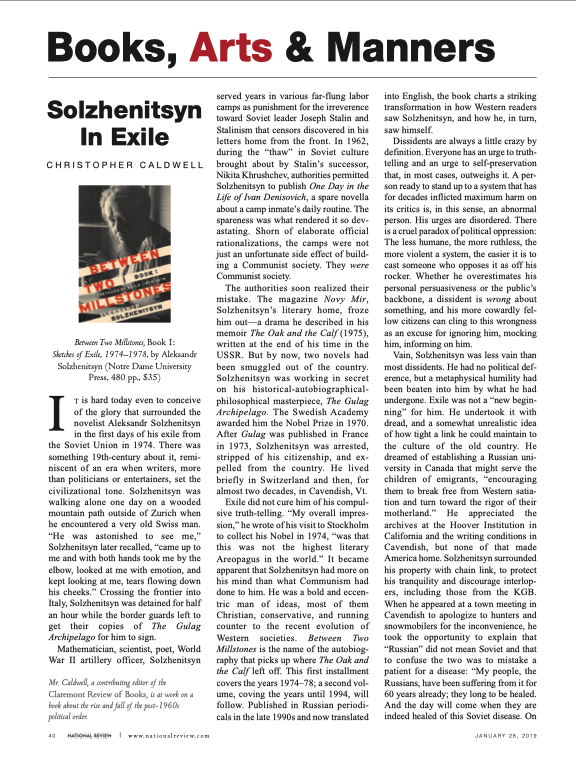
Christopher Caldwell review of Between Two Millstones, Book 1

Screen Shot 2019-01-10 at 21.57.49.png

In the forthcoming National Review, Christopher Caldwell reviews Between Two Millstones, Book 1.

Solzhenitsyn had become convinced that, far from being a reliable defender of others’ liberty, the West was at risk of fumbling away its own. He saw in the rich nations a “blindness of superiority,” a “decline in courage,” relativism, litigiousness, and a sense of responsibility to God that was growing “dimmer and dimmer.” The [Harvard] speech was a turning point in the Cold War, redrawing all its lines in a way that would anticipate the conflicts of our own time. Indeed it was with this speech during the Carter administration, not with the Putin ascendancy in the first decade of this century, that one first began to hear the progressive complaint that “the true Russia, as opposed to the Soviet Union, is a far greater danger to the West,” as Solzhenitsyn lamented. That foolish but durable view is the cornerstone of elite Western thinking about Russia today.
— Christopher Caldwell

Brand-new translation: Solzhenitsyn's "Golden Matrix" speech

National Review website has just published a brand-new translation of Solzhenitsyn's "Golden Matrix" speech, delivered in Zurich on 31 May 1974 in accepting the Italian journalists’ “Golden Matrix” prize. This thoughtful speech, prefiguring many of the key themes of the Harvard Address, has never before appeared in English. Happy reading! (Bonus: see short clip below of the prize ceremony from that day.)

Aleksandr Solzhenitsyn receives the “Cliché d’Oro” (“Golden Matrix”) prize on 31 May 1974 in Zurich.