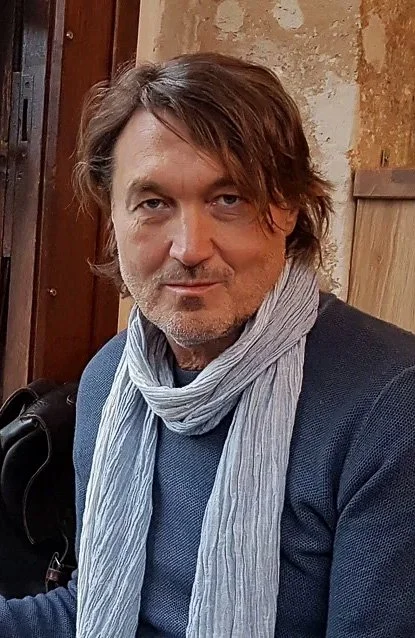
TONIGHT: Live Webcast from Moscow Art Theatre
/Tonight's "main event", with theatre and film star Yevgeny Mironov, from Chekhov's legendary Moscow Art Theatre, will be webcast live at 19h00 Moscow time (0300 Sydney, 16h00 London, 11h00 New York).

Tonight's "main event", with theatre and film star Yevgeny Mironov, from Chekhov's legendary Moscow Art Theatre, will be webcast live at 19h00 Moscow time (0300 Sydney, 16h00 London, 11h00 New York).

Author at his home in Troitse-Lykovo, 2001.
“If, try as we may, we never have been and never shall be able to see, to reflect the truth in all its eternal fresh-minted clarity, is it not because we are still in motion, still living?…”
The celebrated filmmaker Leonid Parfenov reflects on Solzhenitsyn in his popular video log, Parthenon:
City Journal has posted a centennial tribute by Dan Mahoney to Solzhenitsyn and his thought.
“Solzhenitsyn spoke in the name of an older Western and Christian civilization, still connected to the “deep reserves of mercy and sacrifice” at the heart of ordered liberty. It is a mark of the erosion of that rich tradition that its voice is so hard to hear in our late modern world, more—and more single-mindedly—devoted to what Solzhenitsyn called “anthropocentricity,” an incoherent and self-destructive atheistic humanism. Solzhenitsyn asks no special privileges for biblical religion (and classical philosophy), just a place at the table and a serious consideration within our souls. ”

Panel discussion this coming Wed, 12th December at 6.30pm at NYPL. More info here.

The 6th issue of Studying Solzhenitsyn is out, after a (planned) two-year hiatus.
Studying Solzhenitsyn, No. 6 (2018) 408 pp. This issue presents, for the first time, Solzhenitsyn’s recollections of his childhood years and his “long-lost miniature”; selections from the author’s correspondence with Gregory (Afonsky), OCA Bishop of Alaska (1975–79); archival documents illuminating Solzhenitsyn’s military career; and documents pertaining to the author’s 50th-birthday celebrations in 1968. Sections detailing current goings-on in the Solzhenitsyn space include information on the latest editions of Solzhenitsyn’s works, on new scholarly studies or conferences focused on Solzhenitsyn, on special exhibits or permanent museum installations bearing on the writer, on new or imminent theatrical, cinematic, or musical interpretations of his works, and on the latest (2017 and 2018) awards of the Aleksandr Solzhenitsyn Prize in Literature. The issue is rounded out by reproductions of handwritten manuscripts and by photographs.
Contents & Summary (English)
Buy in hardcover (Russian)

An interesting reflection on Solzhenitsyn and patriotism in Crisis Magazine.
“In Russia In Collapse, for instance, Solzhenitsyn explicitly defines patriotism not in reference to any political theory, ancient or modern, but rather characterizes it as “an integral and persistent feeling of love for one’s homeland,” and goes so far as to make the following analogy:
Love for one’s people is as natural as love for one’s family. No one can be faulted for this love, only respected. After all, no matter how much the modern world whirls and jerks about, we still aim to keep intact our family, and we hold it in special regard, suffused with sympathy. A nation is a family, too, except an order of magnitude higher in numbers. It is bound by unique internal ties: a common language, a common cultural tradition, a shared historical memory, and a shared set of problems to resolve in the future.”

The New Yorker “briefly noted” the publication of Between Two Millstones, Book 1.
“In 1974, Solzhenitsyn, the novelist, dissident, and former political prisoner, was deported from the Soviet Union and stripped of his citizenship. In that moment, he was the most famous writer in the world, celebrated—and despised—for his great “literary experiment” chronicling the Gulag Archipelago and for his independence of mind. This first volume of his memoirs covers the next four years, when he lived first in Frankfurt, then in Vermont. It is distinguished mostly by Solzhenitsyn’s descriptions of the initial pain of exile, his bristling reactions to Western mores, and his search for a quiet place to finish his work and live out his life.”
A reflection and review by Stephen Kotkin in the Times Literary Supplement (TLS) of Between Two Millstones, Book 1.
“Many – perhaps most – of Solzhenitsyn’s critics viewed him as an arch-reactionary, a nineteenth-century mind in the twentieth. But in his turn away from Western universalism to nativism and traditional values, in his revolt against liberal condescension, he appears to have foreseen the twenty-first. ”


The eminent Russian scholar Gary Saul Morson reviews Between Two Millstones, Book 1 in the Winter 2019 issue of The American Scholar.
“When Solzhenitsyn called for gradual change to democracy and observed that “it is not authoritarianism that is intolerable, but . . . arbitrariness and illegality,” Western journalists gasped. When he castigated the shallowness of reporters, they accused him of opposing a free press. And when they discovered he had embraced Russian Orthodox Christianity, and hoped for a Russian spiritual rebirth, they called him a dangerous, perhaps fascist, nationalist. This charge particularly mystified Solzhenitsyn, because in his “Letter” he recommend Russia give up its domination over Eastern Europe and let the “peripheral nations” of the Soviet Union go their own way: “Let us find the strength, sense, and courage to put our own house in order before we busy ourselves with the cares of the entire planet.” What sort of nationalist calls for his country to give up its empire?”

Yesterday YMCA-Press, Solzhenitsyn’s long-time publishing house in Paris, released a beautiful new bilingual (Russian and French) complete edition of his Miniatures, containing both the 18 miniatures of 1958–63, and the 14 miniatures of 1996–99. There is a new afterword by renowned Solzhenitsyn scholar Georges Nivat, as well as some useful notes about each miniature. For convenient juxtaposition, and as traditional with bilingual editions, the original Russian text appears verso, and the French translation recto. The translation is the same expert one, by Lucile Nivat and Nikia Struve, that first appeared in 2004 from Fayard.

There is a slew of upcoming events in Moscow to mark the peak of the Solzhenitsyn Centennial. Highlights include the première of a new production of the Alexander Tchaikovsky opera “One Day in the Life of Ivan Denisovich”, conducted by Ignat Solzhenitsyn at the Bolshoi Theatre; the international conference “Aleksandr Solzhenitsyn: Looking Back from the 21st Century”; and a special theatrical production starring Evgeni Mironov at the legendary Moscow Art Theatre. See here for a more comprehensive list.

“Solzhenitsyn, Russian Nobelist and noblest Russian”: The Spectator reviews Between Two Millstones, Book 1.
“I don’t know if this is relevant, to use a Sixties word, to the emigres of our own scattering age, though our rulers might profit from this injunction of Solzhenitsyn’s:
‘The aims of a great empire and the moral health of the people are incompatible. We should not presume to invent international tasks and bear the cost of them so long as our people is in such moral disarray.’
The Soviets at whom he directed this were as obdurately indifferent as Bushes and Clintons to the moral health of their countrymen and the corrosive effects of empire.”

Cavendish's celebration of Aleksandr Solzhenitsyn's 100th birthday will take place on Sunday Dec. 2, 4 pm at the Cavendish Baptist Church. There will be a screening of his farewell address to Cavendish, discussion, and a potluck supper. The Cavendish Historical Society will be providing refreshments. The snow date is Dec. 9 at the same time and place. FMI: margocaulfield@icloud.com or 802-226-7807.
This is a first! Proper currency that will go into circulation soon. Read more here.

David Luhrssen at Shepherd Express and Mark Movsesian at Law and Religion Forum with brief reviews of Between Two Millstones, Book 1.
“Abruptly released by the KGB and sent to the West, Aleksandr Solzhenitsyn was like a man who emerged from a dark room into the blinding light of high noon. ”

Renowned Solzhenitsyn scholar will present a lecture at Oxford University on 23 November 2018, in conjunction with a centenary exhibition that will run through 17 December. More details here.
Ignat Solzhenitsyn, the conductor and pianist, and middle son of Aleksandr Solzhenitsyn, will present an intimate evening of music featured in and inspired by his father’s writings, along with excerpts from those writings, in honor of the centenary of his birth. The program includes piano works by Beethoven and Shostakovich, personal reflections, and a selection of Solzhenitsyn’s compelling poems, some of which will be heard in English for the very first time. This event takes place at the 92nd Street Y in New York City on Monday, 19 November 2018 at 7.30pm. For more details and tickets, go here.


A major three-day conference and exhibit of Solzhenitsyn’s manuscripts entitled, “ALEXANDRE SOLJENITSYNE: UN ÉCRIVAIN EN LUTTE AVEC SON SIÈCLE”, begins in Paris on Monday at the Institut de France and the Sorbonne. More info on the conference website.

Cavendish historian and author Margo Caulfield will speak in Burlington, Vermont on Thu, 15 November as part of Vermont Historical Society’s Third Thursday series. Her topic is “"I Wrote and Waited": Aleksandr Solzhenitsyn’s Life in Cavendish, VT”. The event will be streamed live on Facebook, with viewers able to ask questions.
“Margo Caulfield of the Cavendish Historical Society will share what his life was like and the impact he had on the community. She will also speak about the work being done to commemorate his life in his centennial year.”
The Aleksandr Solzhenitsyn Center
ASC Blog
His Writings
His Life
Landmarks & Exhibits
Photo galleries
Video Library
Resources
Donate
Contact Us
The Aleksandr Solzhenitsyn Center supports explorations into the life and writings of the Nobel Laureate and Russian writer and historian Aleksandr Solzhenitsyn.